VAT and GST on Crypto Invoices, Explained (2026)
A general 2026 explainer on VAT and GST for crypto invoices — why the payment method usually doesn't change the tax, per-line tax handling, and the records you need. Not tax advice.
TL;DR
Paying an invoice in crypto generally doesn't change whether VAT, GST, or sales tax applies — the tax follows the underlying supply of goods or services, not the payment method. What changes is the records side: you need per-line tax handling and the fiat value at payment to report correctly. This is a general explainer, not tax advice; rules vary by jurisdiction.
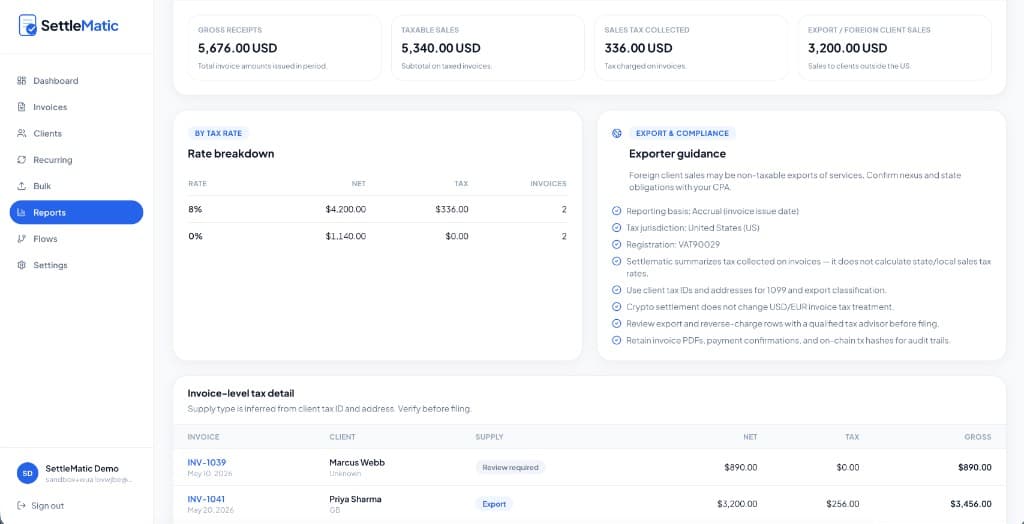
I run product at Settlematic, not a tax authority. Below is orientation plus the tooling implication.
The payment method usually isn't the taxable thing
A common misconception is that accepting crypto somehow alters your indirect-tax obligations. In most systems, VAT/GST/sales tax attaches to the supply — the goods or services you sold — and is calculated on the value of that supply. Whether the customer pays in fiat or crypto, the supply is the same, so the tax treatment of the supply generally doesn't change. You typically still charge, collect, and remit the applicable tax as you would on a fiat invoice. Confirm specifics locally — but don't assume crypto exempts you.
Where crypto does add complexity: the records
The complication is denomination. VAT/GST is reported in your local currency, but the payment arrived as crypto. So you need the fiat value of the payment to report the tax correctly. Two requirements follow:
- Per-line tax on the invoice, not a single invoice-level field — so each taxable line is handled correctly and exports carry it. A single lumped tax field is a known limitation in weaker tools.
- Fiat value at time of payment, recorded automatically, so your tax reporting uses the right base-currency figures.
We built tax buckets and per-line handling for exactly this; see the tax reporting guide.
A simple way to think about it
Treat the crypto invoice as a normal taxable invoice that happens to be settled on-chain. Charge VAT/GST as you normally would, show it per line, denominate in your reporting currency, and make sure your records capture the fiat value at payment. The on-chain settlement is a payment detail; the tax logic sits on the supply.
The bottom line
Crypto doesn't usually change whether VAT/GST applies — it changes the records you need to report it. Use per-line tax and capture fiat-at-payment, then apply your jurisdiction's rules with a professional. To see per-line tax and exports in action, run a free testnet invoice.
Explore Settlematic
Ready to try the workflow in your own workspace? Start on testnet, then explore our how it works guide and product features.
Frequently asked questions
- Does accepting crypto exempt me from VAT or GST?
- Generally no. The tax usually follows the supply of goods or services, not the payment method. You typically charge and remit as on a fiat invoice. Confirm locally.
- Should VAT/GST be per line or per invoice?
- Per line is the robust approach — it handles mixed-rate invoices and exports cleanly. A single invoice-level tax field is a limitation to watch for.
- What value do I use for the tax?
- Your local reporting currency. Capture the fiat value at time of payment so the figures are correct, since the payment itself was in crypto.