Do You Pay Tax on Crypto Invoice Payments? (2026 Overview)
A general 2026 overview of how crypto invoice payments are typically taxed — income at fiat value when received, potential gains on later disposal, and the records you need. Not tax advice.
TL;DR
In most jurisdictions, yes — crypto received for goods or services is generally treated as ordinary income at its fiat value on the day you receive it, just like a cash payment. If the crypto then changes in value before you convert or spend it, that change is often treated separately as a gain or loss. The specifics vary by country, so this is a general overview, not advice — confirm with a qualified tax professional.
I run product at Settlematic, not a tax practice, so treat the below as orientation and the records implication, not a ruling on your situation.
The general principle
Getting paid in crypto for work isn't a tax loophole. Most tax authorities treat a crypto payment for services the same way they'd treat a cash payment: it's income, recognized at the fair market value (in your local fiat currency) on the date you received it. If you invoice a client $2,000 and they pay you $2,000 worth of USDC, you've generally received $2,000 of income — denominated in dollars for tax purposes even though it arrived as crypto.
The second event most people miss
There's often a second taxable consideration. After you receive the crypto, its value may move before you convert it to fiat or spend it. Many jurisdictions treat that subsequent change as a capital gain or loss, calculated from the value when you received it (your cost basis) to the value when you disposed of it. Stablecoins like USDC minimize this because they track the dollar, but volatile assets like ETH or BTC can create a separate gain/loss event on disposal. This is exactly why your records need the value at time of receipt.
Why the records matter more than the rule
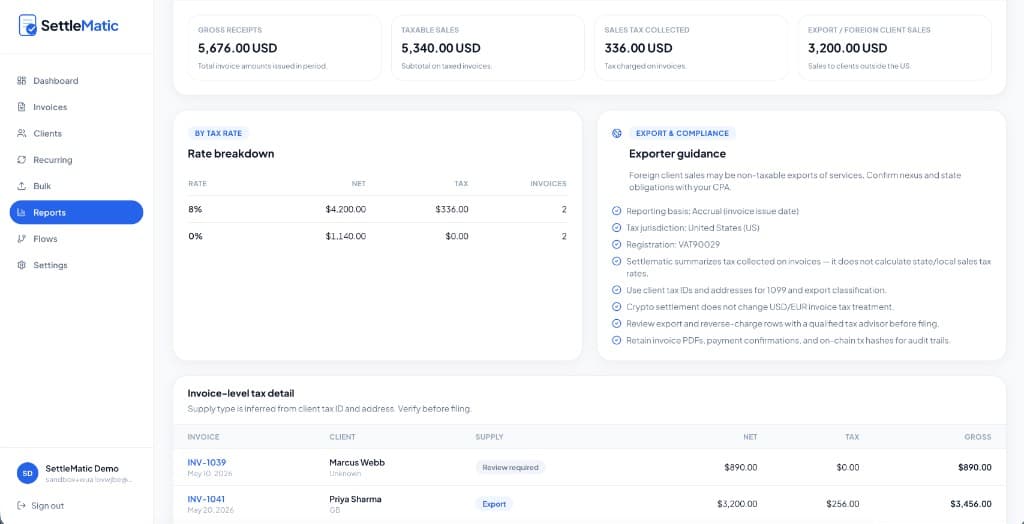
Whatever the precise treatment in your country, the practical requirement is the same: you need the fiat value at the moment of payment, the date, and an invoice reference. A bare wallet doesn't store the fiat value, so reconstructing it later means looking up historical prices transaction by transaction. An invoicing platform records it automatically, which is the difference between a clean filing and a weekend with a price chart. See our tax reporting guide for the records side.
The bottom line
Assume crypto invoice payments are taxable as income, keep records that capture the fiat value at receipt, and confirm the specifics — including any gain/loss treatment on disposal — with a qualified professional in your jurisdiction. Good invoicing records make this straightforward; bad ones make it a chore. Run a free testnet invoice to see what the export captures.
Explore Settlematic
Ready to try the workflow in your own workspace? Start on testnet, then explore our how it works guide and product features.
Frequently asked questions
- Is crypto received for work taxed as income or capital gains?
- Generally, receiving it for services is income at its fiat value on the day received. A later change in the asset's value before you convert or spend it is often a separate capital gain or loss. Treatment varies by jurisdiction.
- Does using a stablecoin change the tax?
- Stablecoins minimize the second event (gain/loss on disposal) because they track the reference currency, but the receipt is still generally income at fiat value. Confirm locally.
- What records do I need?
- At minimum: the fiat value at time of payment, the date, the asset, and an invoice reference. Keep exports rather than relying on a wallet history.