Non-custodial crypto payment gateway for SaaS, platforms, and checkout APIs.
Gateway turns Settlematic into a payment processor you can embed in your product. Onboard merchants, route checkouts, manage compliance workflows, and receive real-time webhooks - while merchants control settlement destinations for confirmed funds.
Hosted · Embedded · iframe · QR checkout · Signed webhooks
Checkout modes
4
Hosted, embedded, iframe, and QR
Webhooks
Signed
HMAC-verified events with replay logs
Merchants
Multi
Onboard and operate from one dashboard
Networks
8
Ethereum, Polygon, Base, Arbitrum, Arc, Solana, Tron, and Bitcoin
Overview
What is Gateway?
Gateway turns Settlematic into a payment processor you can embed in your product. Onboard merchants, route checkouts, manage compliance workflows, and receive real-time webhooks - while merchants control settlement destinations for confirmed funds.
Gateway is Settlematic's crypto payment gateway for platforms - create checkout sessions via API, onboard merchants, and receive signed webhooks while merchants control settlement destinations.
Use hosted pages, iframe embeds, or redirect flows without building wallet infrastructure. Sandbox merchants on testnet mirror production before you go live.
What makes Gateway different from most crypto payment gateways is where the money goes. A typical processor receives a customer's payment into an address it controls, holds it in a pooled balance, and pays the merchant out later - usually minus a percentage of volume. Gateway never takes that position. Every checkout session gets a unique deposit address derived for the merchant's own wallet, so the customer pays the merchant directly; Settlematic detects the transaction on-chain, confirms it, fires a signed webhook to your platform, and sweeps confirmed funds to the destination the merchant configured. There is no balance to freeze, no settlement schedule to wait for, and no per-transaction cut.
Gateway accepts USDC, USDT, EURC, ETH, and BTC across Ethereum, Polygon, Base, Arbitrum, Arc, Solana, Tron, and Bitcoin. Checkout amounts are quoted in fiat and locked for the payment window, so a $49 subscription is exactly $49 of USDC on whichever chain the customer picks. Underpayments, overpayments, and wrong-chain sends are detected and surfaced with recovery flows rather than silently lost. Every payment record carries the transaction hash, confirmation height, fiat value at receipt, and sweep destination, and exports to CSV or JSON for reconciliation.
For platforms and marketplaces, Gateway is multi-merchant by design: onboard sub-merchants with KYB workflows, issue scoped API keys per environment, restrict allowed assets and networks per merchant, and watch every merchant's activity from one operations dashboard - while each merchant's funds still settle to that merchant's wallet, not to yours. Refunds, disputes, subscription plans, and recurring charges are handled at the merchant level with full audit logs.
Workflow
How Gateway works end to end
- 1
Onboard
Create merchant and configure assets/networks
- 2
Integrate
Create payment sessions via API
- 3
Checkout
Customer pays on hosted or embedded UI
- 4
Webhook
Your backend receives payment.confirmed events
- 5
Settle
Funds settle to merchant-controlled destinations bound at issuance
Capabilities
Everything in Gateway - explained
12 capabilities for operators, finance teams, and developers. Jump to a deep dive or explore the full product below.
Checkout
Hosted checkout - redirect and standalone pages
Drop-in payment pages without building crypto UI.
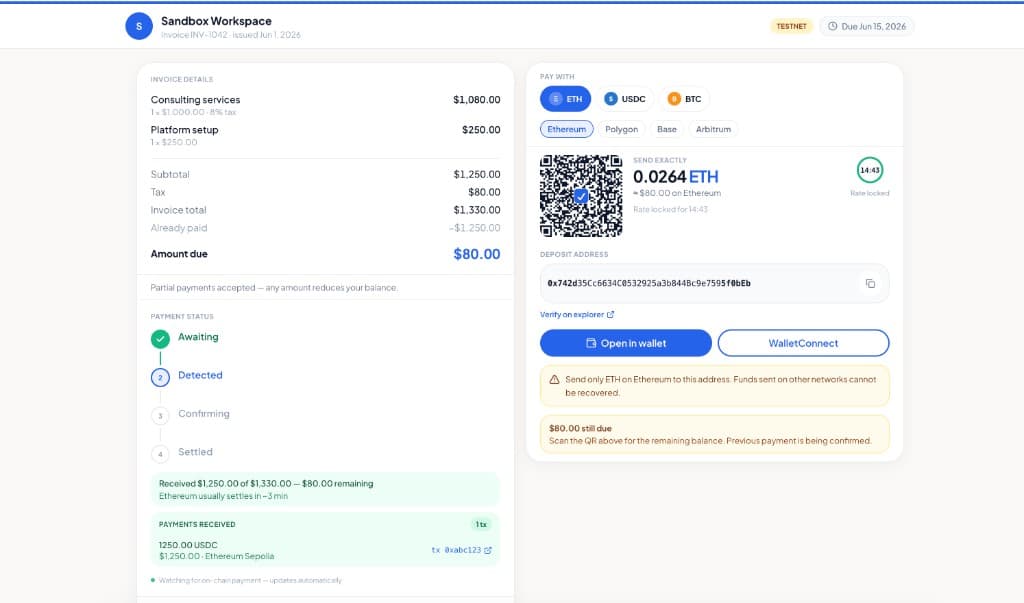
Redirect customers to a hosted checkout URL or share it directly. Same multi-chain detection, partial payment support, and branded experience as Collect - scoped to the merchant context with platform fee breakdowns in webhooks.
- Hosted checkout URL per session
- QR codes on hosted page for mobile wallets
- Multi-chain asset selection at checkout
- Partial and overpayment handling
- Branded logo and colors per merchant
Events
Signed webhooks & event logs
Automate order fulfillment when crypto lands.
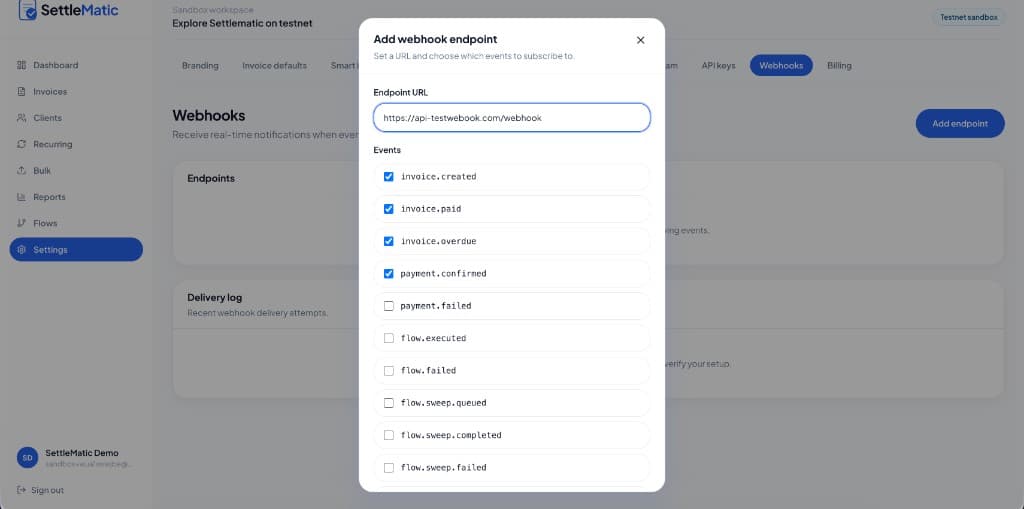
Subscribe to payment.confirmed, payment.detected, refund, and merchant lifecycle events. Every delivery includes an HMAC-SHA256 signature; the dashboard shows payloads, HTTP status, retries, and timestamps so engineering and finance debug from one stream.
- HMAC-SHA256 signature on X-Settlematic-Signature header
- Event log with retry from dashboard
- payment.confirmed for provisioning and order mark-paid
- Idempotent event processing with delivery IDs
- Separate webhook endpoints per merchant
Settlement
Merchant-controlled settlement
Platforms get webhooks; merchants own the destinations.
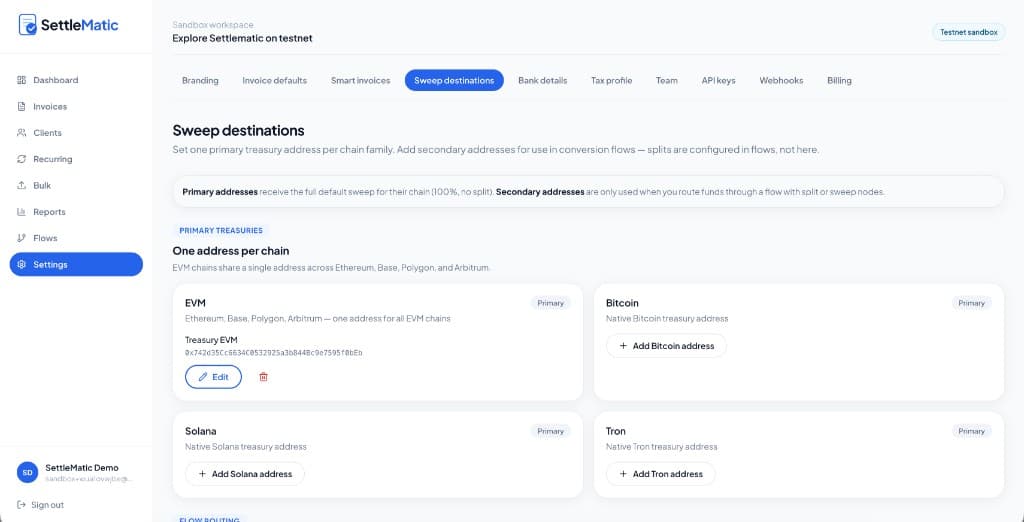
Confirmed payments settle to destinations merchants control - cold storage, operating wallets, or multisig treasuries - bound when each checkout address is issued. Platforms receive fee breakdowns in webhooks for reconciliation. No long-lived processor balance.
- Settlement to merchant-controlled wallets
- Per-merchant destination configuration
- Multi-destination percentage splits
- Platform fee splits in webhook payloads
- No long-lived processor balance or withdrawal queue
Why Gateway
Settlematic Gateway vs custodial payment processors
Platforms need programmatic checkout and webhooks with true non-custodial settlement instead of pooled processor balances. Compare Gateway to typical custodial crypto processors.
| Settlematic Gateway | Typical custodial processor | |
|---|---|---|
| Merchant custody | Merchants control settlement destinations | Processor holds merchant balances |
| Checkout surfaces | Hosted, embed, iframe, and QR | Often hosted only |
| Webhooks | HMAC-signed with replay logs | Varies; often limited debugging |
| Partial payments | Built-in from Collect rails | Often unsupported |
| Sandbox | Full testnet merchants and sessions | Limited or production-only |
Need multi-merchant checkout? See crypto payment gateway.
Use cases
Built for platforms that embed crypto checkout
SaaS platforms
Embed crypto checkout in your product with REST sessions, signed webhooks, and merchant dashboards - without custodial float.
Marketplaces
Onboard multiple merchants, route platform fees in webhooks, and let each seller control settlement destinations for confirmed payments.
Agencies
Run separate merchant profiles per client brand while operating from one org-level compliance and reporting layer.
E-commerce
Map order IDs to checkout sessions, support partial payments, and reconcile gateway events against your cart system.
Start with Gateway
Create a free testnet account and explore the full product in minutes.