What Is Non-Custodial Crypto Invoicing? (Plain-English Guide)
A clear explanation of non-custodial crypto invoicing in 2026 — how invoice-scoped addresses, on-chain detection, and sweeps to wallets you control actually work, and why it matters.
TL;DR
Non-custodial crypto invoicing means the platform you use to bill clients never holds your funds. It generates the invoice, gives the client a place to pay on-chain, detects the payment, and sweeps it to a wallet you control — without ever taking custody of your keys. The opposite, custodial invoicing, holds your funds on the platform's balance until you withdraw. This guide explains the mechanics in plain English and why the distinction matters.
I run product at Settlematic, a non-custodial platform, so I'll be upfront about that and keep the explanation general enough to apply whichever tool you use.
The plain-English definition
"Custody" in crypto means control of the private keys, and therefore control of the funds. Whoever holds the keys can move the money.
In non-custodial crypto invoicing, the platform helps you create and send invoices and helps your client pay — but the funds route to a wallet whose keys you hold. The platform is a coordinator, not a bank. In custodial invoicing, the funds land in the platform's wallets and stay there until you ask to withdraw, which means the platform controls your money in that window.
Same invoice on the surface. Completely different answer to "who has my money right now?"
How the non-custodial flow actually works
Strip away the marketing and the mechanics are straightforward:
- You create an invoice. Fiat-denominated (say, $4,000 in USD), with line items and terms.
- The platform derives a deposit address for that invoice. A unique, invoice-scoped address — not a shared pool. This makes reconciliation cleaner and limits address reuse.
- Your client pays on-chain. They open a hosted payment page, choose an asset and network, see a fiat-quoted crypto amount, and send the funds.
- The platform detects the payment on-chain. It watches the address and confirms when the funds arrive, updating the invoice status (for example, to PAID or PARTIALLY_PAID).
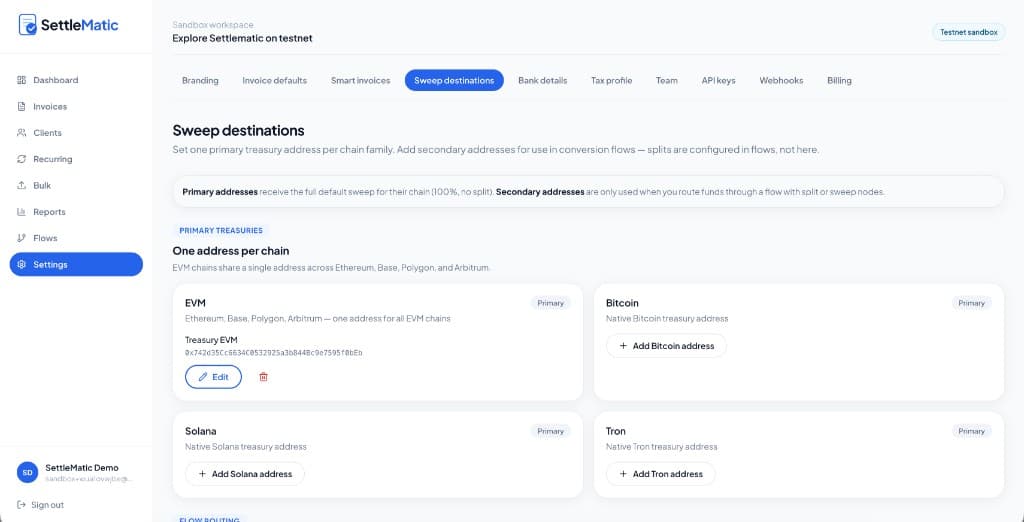
- The funds sweep to a wallet you control. The platform routes the payment to a destination you configured — and can split it by percentage across, say, an operating wallet and a reserve. At no point does the platform hold your keys.
That fifth step is the whole point. The money moves to you, not into a platform balance you later have to withdraw from.
Why invoice-scoped addresses matter
Deriving a fresh address per invoice isn't just tidy — it's what makes crypto behave like accounts receivable. When each invoice has its own deposit address, an incoming transfer maps unambiguously to a specific invoice and client. That's how you avoid the quarter-end ritual of reconstructing which wallet transfer paid which job from a block explorer. It's also better for privacy and reduces the risks that come with reusing one address for everything.
What non-custodial protects you from
The benefit is concentrated in one place: counterparty risk. Because your funds are swept to your own wallet, a problem at the platform — a withdrawal freeze, a policy change, an insolvency, an operational outage — doesn't trap your money. If the platform vanished overnight, the funds already paid out are in your wallet, not in a queue. For any business holding meaningful receivables, that's a structural protection worth understanding. We compare the two models in depth in custodial vs non-custodial [crypto invoicing](/blog/custodial-vs-non-custodial-crypto-invoicing).
What it asks of you in return
Non-custodial isn't magic; it relocates responsibility:
- You hold the keys, so you secure them. Backups, access control, and wallet hygiene are yours.
- Protect the billing admin account. Since you control where funds sweep, account-takeover protection matters. Good platforms add cooldown windows on destination-wallet changes so an attacker can't instantly redirect funds — but enforcing 2FA and resisting phishing is still on you.
This is a fair trade for most businesses: you take on key security in exchange for not handing a third party control of your cash flow.
A common misconception
Non-custodial does not mean "harder for your client." From the payer's side, a non-custodial invoice looks like any hosted checkout — a link, an asset choice, a QR code, a fiat-quoted amount. The custody model lives on your side of the transaction, in where the funds end up. Your client never has to know or care.
Is non-custodial right for you?
If you're billing real revenue and can pair it with basic security discipline, non-custodial is usually the safer default because it removes platform counterparty risk from your treasury. If your crypto volume is tiny and experimental, the simplicity of a custodial tool can be defensible — just know what you're trading away. The decision framework is in our buyer's guide.
See it in practice
The fastest way to understand non-custodial invoicing is to watch one happen. You can create a free workspace and run a testnet invoice — send it, pay it from a test wallet, and watch the funds sweep to a destination you control. Ten minutes makes the concept concrete. You can also read how our treasury and sweeps implementation handles routing.
Explore Settlematic
Ready to try the workflow in your own workspace? Start on testnet, then explore our how it works guide and product features.