Custodial vs Non-Custodial Crypto Invoicing: Which Is Safer for Your Treasury?
A clear comparison of custodial and non-custodial crypto invoicing in 2026 — where your funds sit, who holds the keys, the real trade-offs, and how to decide for your treasury.
TL;DR
The difference comes down to one question — who controls your funds in the window between a client paying and you withdrawing? Custodial platforms hold the funds; non-custodial platforms sweep them to a wallet you control. Custodial is simpler to support but concentrates counterparty risk. Non-custodial removes that risk but asks you to own key security. For most businesses billing material revenue, the architecture is a treasury decision, not a feature preference.
I run product at a non-custodial platform (Settlematic), so I'll be explicit about that bias and try to give the custodial model a fair hearing.
The distinction in one paragraph
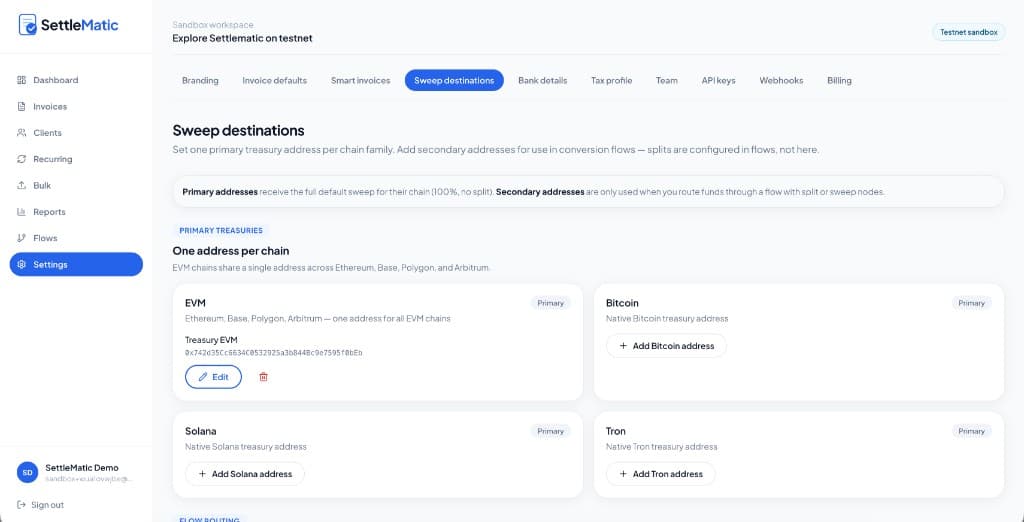
When a client pays a crypto invoice, the funds arrive on-chain. In a custodial model, they land in wallets the platform controls and sit there — on the platform's balance sheet — until you request a withdrawal. In a non-custodial model, the platform derives a unique deposit address for the invoice, detects the incoming payment, and sweeps it to a destination wallet you configure and control. The platform orchestrates the movement but never holds your private keys. Everything else — the invoice, the PDF, the checkout — can look identical. The custody model is what changes underneath.
What the custodial model gets right
It would be dishonest to pretend custodial is all downside. For some teams it's the rational choice:
- Simpler support. When funds sit in the platform's wallets, the platform absorbs gas management, failed-transaction edge cases, and chain reorganizations. You see a balance, not a mempool.
- Familiar onboarding. Custodial processors often have mature KYC and compliance flows that some merchants find reassuring, especially in regulated contexts.
- One relationship. If you want a single vendor handling acceptance, conversion, and payout, custodial bundles that neatly.
If your crypto volume is small and experimental, the convenience can outweigh the risk. The cost of that convenience is what you give up, which is the next section.
What the custodial model costs you
The trade-off is concentrated in one word: dependency. With custodial settlement, a withdrawal delay, a policy change, a freeze, or a counterparty event at the platform sits directly between you and your money. You've seen this play out across the industry — the risk isn't theoretical. Your treasury is only as safe as the custodian's worst week. For a business holding meaningful receivables, that's a structural exposure you don't control and can't fully diligence from the outside.
What the non-custodial model gets right
Non-custodial architecture is built so the platform never becomes a single point of failure for your funds:
- You hold the funds. Payments sweep to wallets you label and control. If the platform disappears tomorrow, your money is already in your wallet, not stuck in a withdrawal queue.
- Invoice-scoped addresses. A unique deposit address per invoice makes reconciliation cleaner and limits address reuse.
- Configurable routing. Good non-custodial tools let you sweep with percentage splits — for example, routing to an operating wallet and a reserve wallet automatically.
- Account-takeover mitigations. Mature implementations add cooldown windows on destination-wallet changes, so an attacker who gets into your account can't instantly redirect funds.
This is the model we built Settlematic on; you can see how it works in treasury and sweeps.
What the non-custodial model asks of you
Non-custodial isn't a free lunch — it relocates responsibility rather than removing it:
- You secure your own keys. The destination wallets are yours, which means key management, backups, and access control are yours too.
- 2FA and admin hygiene matter more. Since you control routing, protecting the billing admin account against phishing and takeover is on you. Cooldown windows help, but discipline is the real defense.
- You should understand the flow. Knowing that funds are detected on-chain and swept gives you confidence; treating it as a black box does not.
Neither model removes the obligation to run your own security well. The architecture decides where the funds sit if the vendor fails — it doesn't decide whether you've enforced 2FA.
A simple way to decide
Ask three questions about your own situation:
- How much revenue runs through this? The more material the receivables, the more the counterparty risk of custodial weighs against you, and the more non-custodial earns its place.
- Do you have anyone who can own key security? If literally no one on the team can responsibly hold a wallet, custodial's simplicity has real value — though that's also a sign to fix the gap, not avoid it forever.
- What's your tolerance for vendor dependency? If a withdrawal freeze would genuinely hurt, that's your answer.
For most agencies, SaaS companies, and services firms billing real money, non-custodial is the safer default for the treasury — provided you pair it with basic security discipline. For a tiny experimental flow, custodial convenience can be defensible.
The one question to put to any vendor
Regardless of which way you lean, make every platform answer this in plain language: "Where do funds sit between the moment my client pays and the moment they reach my cold wallet, and who holds the keys during that window?" A vendor that can't answer clearly, or buries it in documentation, is telling you something. We included this in the seven questions for every vendor demo.
The bottom line
Custodial trades control for convenience; non-custodial trades convenience for control. For a serious treasury, control usually wins — but only if you back it with key security and admin hygiene. If you want to see the non-custodial flow end to end without risking real funds, you can run a testnet invoice and watch the sweep.
For the conceptual foundation, read what is non-custodial [crypto invoicing](/blog/what-is-non-custodial-crypto-invoicing).
Explore Settlematic
Ready to try the workflow in your own workspace? Start on testnet, then explore our how it works guide and product features.