Best Crypto Payment Gateway in 2026: An Honest, Technical Comparison
A deeply technical comparison of crypto payment gateways in 2026 - custody, AI agent readiness, x402 support, multi-currency settlement, tax reporting, and the gaps every merchant should know before choosing one.
Do this next
Compare custody models
- Custodial processors hold keys and convert.
- Non-custodial settlement binds addresses to your wallet.
- Use the table below for the attribute-level split.
The best crypto payment gateway in 2026 depends on custody: custodial processors (BitPay, Coinbase Business, CoinGate) hold funds and charge 1-2% plus fiat off-ramp; non-custodial gateways like Settlematic settle directly to your wallet at a flat fee. Choose custodial if you need bank euros or dollars tomorrow; choose non-custodial if you keep treasury on-chain and want no processor in the money path.
TL;DR
The "best crypto payment gateway" is no longer a single product category. In 2026 the market has fractured into custodial card-replacement processors (BitPay, Coinbase Commerce, CoinGate), stablecoin settlement networks (BVNK, Triple-A, Stripe USDC), self-hosted Bitcoin servers (BTCPay), agentic payment rails (x402 facilitators), and unified crypto finance platforms. The right choice depends on three questions: (1) Where do the funds settle first - your wallet or the gateway's? (2) Can the gateway handle modern payment shapes - multi-transaction, multi-currency, multi-chain, and machine-to-machine? (3) Does it close the loop on tax, treasury, and yield, or does it stop at the checkout button? This guide answers all three, names what's actually still broken in the market, and explains where Settlematic fits - including what we do not yet solve.
Why "Best Crypto Payment Gateway" Is the Wrong Question (Until You Pick a Framework)
Most "best of" lists in this category rank by coin count, brand recognition, or advertised fee. None of those tell you what actually matters when revenue starts flowing.
A gateway that supports 350 coins but holds your funds, requires KYC from your customers, and exports a CSV your accountant can't reconcile is not better than one that supports five stablecoins and lands every payment directly in your wallet. Aggregation of altcoins is mostly noise - independent research and merchant data show that the overwhelming majority of merchant crypto revenue moves through five assets at most: USDT, USDC, Bitcoin, Ethereum, and BNB.
Before comparing providers, fix the framework. A modern crypto payment gateway should be evaluated on ten dimensions, not three:
- Custody model - does the gateway touch your funds, or do payments settle peer-to-peer to a wallet you control?
- Chain and asset coverage - the chains your buyers actually use (Ethereum, Polygon, BSC, Solana, Tron, Bitcoin) versus a long-tail of altcoins almost nobody pays in.
- Payment shape support - single-transaction is solved; what about partial payments, multi-currency for one invoice, multiple senders, and machine-to-machine micropayments?
- Agentic readiness - is the gateway addressable by software agents over HTTP, or is it locked behind a redirect-to-hosted-checkout?
- x402 and protocol-level standards - does it speak the protocols that the AI economy is consolidating around?
- Programmable settlement - once funds land, can you auto-sweep, split, swap, or bridge them, or do you do it manually in a wallet?
- Tax and accounting integration - Form 1099-DA, DAC8, and CARF reporting are not optional anymore.
- Treasury and yield - idle stablecoin balances earning zero is now a quantifiable opportunity cost.
- Integration surface - REST API, signed webhooks, language SDKs, e-commerce plugins, and CLI for AI-first teams.
- What it doesn't solve - every gateway has limitations imposed by the underlying networks. The honest ones tell you what those are.
The rest of this guide walks each dimension, names how the market is doing on each, and is explicit about where Settlematic genuinely solves a gap versus where the underlying technology is still hard for everyone.
What Changed in 2026: The Market Fractured Along Five Lines
Crypto payments in 2022 was a single product category - "accept Bitcoin, settle in USD." That category no longer exists. As of mid-2026, the market has split into five distinct segments, each solving a different problem:
- Card-replacement processors. BitPay, Coinbase Commerce, CoinGate, NOWPayments. These behave like Stripe: a customer pays in crypto, the processor converts and pays the merchant in fiat or a stablecoin. Almost all of them are custodial - the funds pass through the processor's balance sheet before reaching you.
- Stablecoin settlement networks. BVNK, Triple-A, and Stripe's USDC product. These treat stablecoins as a clearing rail and bolt fiat banking infrastructure on top - virtual IBANs, ACH payouts, multi-currency conversion at settlement. BVNK alone processes over $25 billion annually.
- Self-hosted sovereign stacks. BTCPay Server is the original example. You run a node, manage your own wallet, never pay a processor fee. Maximum control, maximum operational burden.
- Agentic payment rails. A new segment built around x402 and adjacent protocols (A2A, AP2). Coinbase, Cloudflare, Vercel, Zuplo, Alchemy and others have shipped or are piloting facilitators for machine-to-machine payments. x402 alone processed over 100 million payments in its first year and has been contributed to the Linux Foundation under a new x402 Foundation with Google, Visa, AWS, Circle, Anthropic, and Vercel as founding members.
- Unified crypto invoicing and checkout platforms. The newest segment - invoicing and embeddable checkout under one ledger, with non-custodial deposit detection and sweeps to merchant-configured destinations. This is the segment Settlematic is building.
These segments are not always competing for the same customer. A high-volume EU e-commerce merchant who wants EUR settlement looks very different from a SaaS team selling API access to AI agents. Treating them as one ranked list is how most comparison guides go wrong.
The Problems Still Open in the Crypto Payment Gateway Market
Before describing what any gateway solves, here is what most still don't - and why.
1. Custody risk dressed up as convenience
Most well-known crypto payment gateways are custodial. When a customer pays, the funds first land in the processor's omnibus wallet, then are settled to the merchant on a schedule. This is a structural risk, not a hypothetical one. Several gateways have been forced into operational shutdowns, regulatory holds, or insolvency events over the past five years, and merchants discovered the difference between "your money" and "your balance with the processor" after the fact.
A processor calling itself "non-custodial" but holding funds for any period - even minutes for conversion - is still custodial. The question that cuts through marketing language is simple: when your customer pays, where does the money go first? If the answer is "to us, then to you," it is custodial regardless of branding.
2. The checkout-page paradigm assumes a human
Almost every crypto payment gateway built before 2024 assumes a human will be looking at a checkout page. A QR code is generated, an address is displayed, a 15-minute timer starts. The customer scans, copies, pastes, and clicks.
That model breaks for two new buyer types: AI agents and high-volume B2B systems. An autonomous agent doesn't fill in a checkout form, doesn't open a wallet extension, and cannot wait 15 minutes for a human approval step. Goldman Sachs estimates AI agent spending on digital services could reach $50 billion annually by 2028, and most existing gateways have no native rail for that traffic.
3. Single-currency, single-transaction lock-in
Most gateways generate one address, denominate it in one currency on one chain, and expect one transaction to clear it. If the buyer's wallet holds half in USDC on Polygon and half in USDT on Tron, that's two checkouts or a manual swap. If the buyer wants to send 60% now and 40% next week, the gateway either expires the invoice or treats the second payment as an unrelated transfer.
Real B2B payments don't behave like e-commerce. Treasury teams pay from the wallet they have liquidity in, in the asset they have liquidity in, and sometimes across multiple wallets. A gateway that can only consume one transaction per invoice is a gateway that creates manual reconciliation work for every non-trivial payment.
4. No programmable destination
Funds land in a single wallet. What happens next is the merchant's problem. A team that wants to keep 70% as USDC on Base, sweep 20% into a treasury cold wallet, swap 10% to ETH for gas, and route the remainder into a yield position is writing scripts or hiring a treasury operator.
This is solvable with on-chain primitives - but almost no payment gateway exposes them as first-class features. Settlement is treated as the end of the workflow, not a programmable trigger.
5. Tax reporting that arrives a year late
Starting with the 2025 tax year, US digital asset brokers - which includes most custodial payment processors - must issue Form 1099-DA to merchants and to the IRS. In the EU, the DAC8 directive went into effect in 2026 requiring crypto service providers to report transaction data to tax authorities. The OECD's Crypto-Asset Reporting Framework (CARF) has been adopted by over 50 countries, with the first information exchanges expected in 2027.
The merchant's problem isn't that the IRS will come asking. It's that most gateways export a generic CSV of transactions with no cost basis, no fair-market-value-at-receipt in fiat, and no per-wallet basis tracking - which the IRS now requires per-wallet, not pooled. When April arrives, the merchant pays a CPA to reconstruct what the gateway should have captured at the moment of payment.
6. Idle stablecoins earn nothing
A merchant holding $200,000 in USDC on a payment gateway's balance is foregoing roughly $9,000-$11,000 a year at prevailing stablecoin yield rates. On-chain yield protocols and tokenized treasury products have made this a solved problem from the technology side - but almost no payment gateway integrates them. The default is: payment lands, sits in a wallet, depreciates against opportunity cost until the merchant moves it manually.
7. The all-in-one gap
A typical crypto-native business needs to send invoices, accept checkout payments, sweep settled funds to wallets it controls, and reconcile all of it for accounting. The current market often answers this with separate vendors: an invoicing tool, a payment gateway, a sweep script, and a tax tool. Each has its own webhook signature, its own data model, and its own export. Reconciliation is the merchant's problem.
8. The unique-address-per-payment limitation when buyers pay from exchanges
This one is genuinely hard, and it matters to discuss honestly because no gateway has fully solved it.
Best-practice crypto invoicing generates a unique receiving address per invoice, which makes reconciliation deterministic - every payment maps to exactly one invoice. This works perfectly when the buyer pays from a self-custodial wallet. It breaks down when the buyer withdraws from a centralized exchange, because:
- The exchange's withdrawal system sends from the exchange's hot wallet, not from the buyer's identifiable address. Two different buyers withdrawing from the same exchange look identical on-chain.
- Some exchanges batch withdrawals - your "unique" invoice address may receive a transaction that aggregates several customers' withdrawals.
- A small but non-zero number of exchanges still strip or modify memo/tag fields on certain chains.
The mitigation is layered: unique addresses per invoice (which still works because the address is unique, even if the sender is shared), strict amount matching, transaction memos where supported (Tron, Solana, BSC support attaching reference data through smart-contract calls), and time-window correlation. None of this is a complete solution. A payment from an exchange may still need a human to confirm against an order number the customer enters at checkout.
Every gateway, including Settlematic, has to deal with this. The honest answer is: it's a network-level limitation that is mitigated, not eliminated.
What the New Requirements Look Like in 2026
Before getting to Settlematic specifically, three things are non-negotiable for any gateway serious about the next three years.
Agentic payment readiness and x402
x402 is an open protocol that puts the long-reserved HTTP 402 ("Payment Required") status code to work. A client (human browser or AI agent) requests a paid resource, the server returns 402 with payment terms in a structured JSON header (amount, asset, recipient, chain, nonce), the client signs a stablecoin transfer matching those terms, and the server verifies the on-chain payment and returns the resource. The whole exchange happens over standard HTTP without account creation, API keys, or human approval.
Why this matters for payment gateways: agent traffic isn't a future use case anymore. AI agents are already calling APIs, consuming data feeds, executing trades, and orchestrating multi-step workflows. They need a payment mechanism that is as programmable and instant as the HTTP calls they're already making. The x402 Foundation now includes Google, Visa, AWS, Circle, Anthropic, Vercel, Stripe, and Mastercard. Coinbase, Stripe (via its Agent Commerce Protocol), and Visa (via Trusted Agent Protocol) have all wired x402 into their stacks.
A gateway in 2026 that cannot expose paid endpoints over x402 is choosing not to serve the fastest-growing buyer segment on the internet.
Stablecoin settlement as default
The stablecoin market cap crossed $230 billion in March 2026. The GENIUS Act, signed in the US in July 2025, gave stablecoins a clear federal regulatory framework. Visa is processing $3.5 billion annualized in stablecoin settlement volume. Stripe has built its entire crypto product around USDC.
For merchants, this means three things: (a) buyer demand has shifted decisively to stablecoins over volatile assets, (b) the regulatory ambiguity that pushed earlier merchants toward instant-convert-to-fiat is largely resolved for compliant USDC/USDC issuance, and (c) holding stablecoins on the balance sheet is now an operational decision, not a compliance risk.
A gateway that still treats Bitcoin as the headline asset and bolts stablecoin support on as an afterthought is solving for 2018, not 2026.
Programmable settlement, not just acceptance
In 2026, "accepting a payment" is half the problem. The other half is what happens in the 10 seconds after settlement: does the gateway sweep the funds into a treasury wallet, split between operating and reserve, swap a portion to gas, bridge to the L2 where your team operates, route some into yield? Every one of these is a script someone is writing right now, and almost none of it should be merchant infrastructure.
A modern payment gateway is a programmable settlement primitive, not a payment-acceptance widget.
How Settlematic Handles Each Gap
This is the section where every comparison post veers into marketing. The discipline here is to describe what Settlematic actually does and to be explicit about what it doesn't.
Settlematic is a crypto finance platform built around Collect (invoicing) and Gateway (checkout) on a single ledger. It supports USDC, USDT, and EURC across six chains: Ethereum, Polygon, BSC, Solana, Tron, and Bitcoin. After confirmation, funds can be swept to destinations the merchant configures.
Deposit addresses and merchant sweeps
Every invoice, payment link, and checkout generates a non-custodial deposit address for payment detection. Settlematic monitors the chains, detects payment, reconciles it to the invoice, and fires webhooks. After confirmation, sweeps can move funds to merchant-configured destinations. Settlematic does not currently offer integrated MPC wallet providers.
This architecture answers detection and reconciliation. Merchants still configure and verify their own sweep destinations; treat deposit-address management as part of the platform's settlement path until a fully merchant-keyed redesign ships.
x402 support and AI agent readiness
Settlematic exposes paid endpoints and payment requests over x402 in addition to the standard REST API. An AI agent can hit a Settlematic-protected resource, receive a 402 response with payment terms, sign and broadcast a stablecoin payment, and complete the original request - all over standard HTTP with no account, no API key, no human approval.
This matters because the same Settlematic instance now serves three traffic types from one code path: humans paying at hosted checkout, B2B clients paying invoices, and AI agents paying for API calls or data. Most gateways were built for the first; some were extended for the second; almost none were architected for the third.
For teams building AI-native products - agent frameworks, MCP servers, data marketplaces, inference APIs - this collapses what would otherwise be two payment integrations (a gateway for human revenue, a separate agentic facilitator for machine revenue) into one.
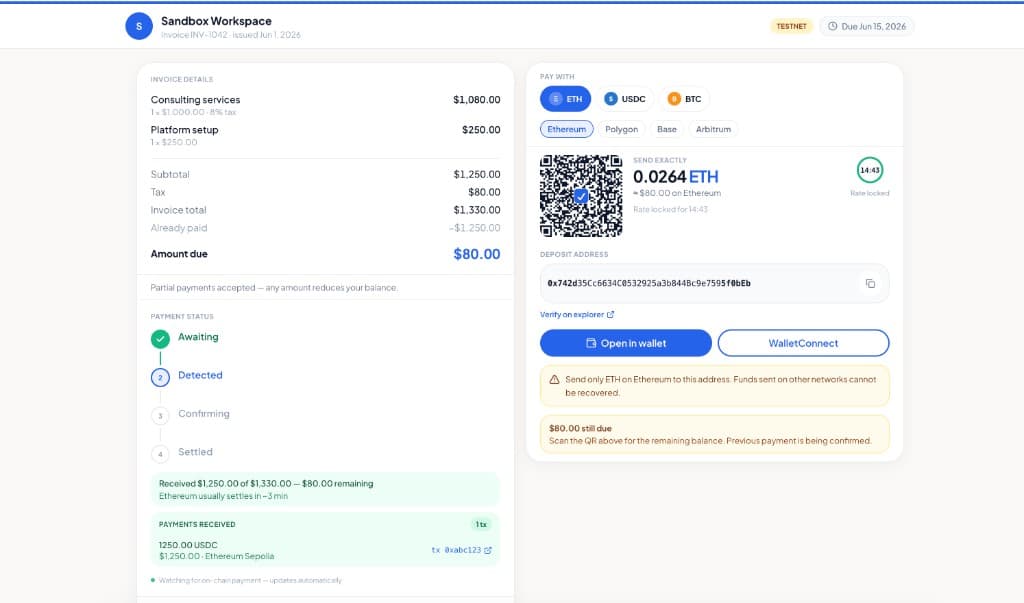
Multi-transaction, multi-currency, multi-chain settlement for a single invoice
A Settlematic invoice for $4,250 can be paid by the buyer in any combination of supported stablecoins across any combination of supported chains, across multiple transactions, until the dollar value sums to the invoice total at on-chain detection time.
A practical example: an agency invoices a client for $10,000. The client pays $4,000 in USDC on Polygon from their treasury wallet, $3,500 in USDT on Tron from their operations wallet, and the remaining $2,500 in EURC on Ethereum from a third address two days later. Settlematic detects all three transactions, values each at the FX rate at the moment of confirmation, reconciles the invoice to "paid in full," and fires a single completion webhook.
This is not a feature most gateways have. The standard model is one invoice, one address, one currency, one transaction. The multi-everything model matches how real B2B finance teams actually move money.
Programmable Flows after settlement
Settlematic Flows are declarative post-settlement rules. A merchant can define, for example: "When USDC on Polygon lands on this address, sweep 70% to a cold wallet on Ethereum, swap 20% to ETH for gas, route 10% to a yield position." Flows are orchestrated by the platform against configured destinations.
Supported actions include sweeps, split-and-sweep, swaps via aggregator routes, cross-chain bridges, gas top-ups, and yield routing. The merchant defines the rule once in the dashboard or via API; Settlematic orchestrates the execution.
The principle: post-settlement movement is part of the payment, not a separate workflow.
Built-in tax reporting
Every payment captured by Settlematic is logged with the on-chain transaction hash, the asset, the chain, the gross amount, the USD/EUR fair-market value at the moment of confirmation, the invoice or customer reference, and the receiving wallet. Per-wallet basis is preserved, which is what the IRS now requires under the post-universal-method rules.
Reports export in formats aligned with Form 1099-DA (for US merchants), Form 8949 reconciliation worksheets, and DAC8-aligned schemas (for EU merchants). For merchants on accrual accounting, the export distinguishes recognition events from settlement events.
This is not a substitute for a CPA. It is a substitute for the spreadsheet a CPA otherwise reconstructs in March.
Stablecoin yield on idle balances
Idle balances can optionally be routed into yield positions through the Flows system against protocols the merchant chooses. Settlematic surfaces position size, APY, and exit liquidity in the dashboard.
One ledger across invoicing and checkout
Crypto-native businesses often need both. Settlematic runs Collect and Gateway on a single ledger, which means a client invoice paid in USDC and a customer checkout paid in USDT land in one reconciliation view, with one webhook signature scheme, one set of permissions, and one export.
The alternative - invoicing tool + payment gateway + accounting glue - is what most teams currently run, and it is where most of their reconciliation pain originates.
Integration surface
Settlematic ships a REST API, signed webhooks (HMAC over the request body with timestamp validation to prevent replay), and SDKs in TypeScript, Python, and Go. Plugins are available for Shopify and WordPress/WooCommerce for merchants who want one-click installation. A CLI is available for AI-native and agentic teams that want to drive Settlematic from terminal or CI rather than a dashboard.
The CLI is worth a brief note: it exists because agentic teams build differently. An MCP server developer needs to spin up a paid endpoint from the command line, test it against a sandbox, generate API credentials, and deploy without opening a browser. The CLI compresses what would be a 15-minute dashboard onboarding into three commands.
What Settlematic Does Not Solve (Yet)
This is the part most comparison posts skip. Skipping it is dishonest. Every gateway has limitations imposed by the underlying networks or its scope; the question is whether the team building it tells you what they are.
The exchange-withdrawal sender-identification problem
As discussed above, when a buyer pays from a centralized exchange, the sender address is the exchange's hot wallet, not a wallet uniquely tied to that buyer. Settlematic mitigates this with unique invoice addresses (the receiving side is always unique), strict amount matching, on-chain memo capture where supported (Tron, Solana, and BSC token transfers can carry reference data), and time-window correlation. We also support a manual reconciliation queue for the residual cases.
This problem has no clean technical solution at the gateway layer. It needs to be solved at the exchange withdrawal-flow level - exchanges propagating a payment reference at the time of withdrawal - and that is a multi-party industry coordination problem, not a Settlematic engineering problem.
Fiat off-ramp at scale
Settlematic settles in stablecoins. If a merchant needs to convert USDC to USD and have it land in a US bank account, that is currently a separate workflow handled through partner off-ramp providers. We are not BVNK or Stripe - we don't run an EUR/USD/GBP fiat banking stack. For merchants whose entire business model requires automatic fiat settlement, a stablecoin settlement network may be the better fit.
Card-network parity for casual consumer checkout
A consumer who just wants to type a credit card number and click "Pay" is not the customer Settlematic is optimized for. That buyer is served better by gateways that put a card form in front of crypto settlement (Stripe USDC, NexaPay, Triple-A). Settlematic optimizes for the buyer who is already in crypto, for B2B clients with operating wallets, and for the rapidly growing agentic segment.
Bitcoin Lightning Network
Settlematic supports on-chain Bitcoin but does not currently offer Lightning Network checkout. For high-frequency, low-value Bitcoin payments, a Lightning-native gateway (BTCPay Server with LND, Strike) is the better choice. We may add Lightning if the demand from our customer base supports it; right now, stablecoin micropayments via x402 cover most of the same use case more cleanly.
Network-level chargeback impossibility
Crypto transactions on the base layer are irreversible. This is a feature for fraud prevention (no chargebacks) but a limitation for genuine disputes. Settlematic handles this with explicit refund flows - the merchant initiates an on-chain refund from their own wallet, which Settlematic orchestrates and records - but the underlying irreversibility is a property of the chains, not something a gateway can change.
Side-by-Side: How the Major Gateways Compare
This is a feature-level comparison across what we've described. It is not a ranking - the right choice depends on which problems matter most to your business.
| Capability | BitPay | Coinbase Commerce | NOWPayments | CoinGate | BTCPay Server | Stripe USDC | BVNK | Settlematic |
|---|---|---|---|---|---|---|---|---|
| Custody model | Custodial | Custodial | Custodial | Custodial | Non-custodial (self-hosted) | Custodial | Mixed | Platform deposits → merchant sweeps |
| Funds settle directly to merchant wallet | No | No | No | No | Yes | No | Configurable | After sweep |
| x402 / agentic payments | No | Yes (Coinbase facilitator) | No | No | No | Yes | No | Yes |
| Multi-tx, multi-currency for one invoice | No | No | Partial | No | Limited | No | No | Yes |
| Programmable post-settlement flows | No | Limited | No | No | DIY scripts | Limited | Yes (enterprise) | Yes (built-in) |
| Stablecoins on 6+ chains | Limited | USDC on Base focus | Yes (350+ tokens) | Limited | Bitcoin-focused | USDC on 3 chains | Yes | Yes |
| Built-in tax export (1099-DA / DAC8 aligned) | Partial | Partial | No | Partial | No | Partial | Yes | Yes |
| Yield on idle balances | No | No | No | No | No | No | Yes (enterprise) | Yes (via Flows) |
| Unified invoicing + checkout | No | No | No | Partial | No | No | Partial | Yes |
| Shopify / WordPress plugins | Yes | Yes | Yes | Yes | Yes | Yes | No | Yes |
| Language SDKs (TS/Py/Go) | Partial | Yes | Yes | Yes | Community | Yes | Yes | Yes |
| CLI for AI-native teams | No | Partial | No | No | Yes (server admin) | No | No | Yes |
| MiCA / regulatory licensing in EU | No | Partial | No | Yes | N/A | Yes | Yes | In progress |
Notes: This table reflects publicly documented capabilities as of mid-2026. Vendor positioning evolves rapidly in this market - verify against current docs before committing.
Architecture Notes: What Actually Happens When a Payment Lands
For technical readers, the question "how does the gateway actually work" tends to surface real differentiation. Here's what a Settlematic payment looks like under the hood.
Address generation
When a merchant creates an invoice or payment link, Settlematic derives a fresh receiving address for that invoice (HD derivation or CREATE2 on EVM where applicable). The address is unique per invoice and used for payment detection and reconciliation.
Chain monitoring
Settlematic runs dedicated indexers across the six supported chains. New blocks are processed within seconds of finalization. Transactions involving any merchant address are matched against the open invoice set using a combination of receiving-address match, amount-tolerance window, and asset-chain pair.
Race condition handling
A common bug pattern in payment systems is double-processing the same on-chain transaction when both the indexer and a webhook arrive close together. Settlematic uses an insert-first pattern with an externalTxId unique constraint at the database layer - the first writer wins, the second writer returns an idempotent success, and the application logic is unconditionally safe to retry.
Webhook delivery
Webhooks are signed with HMAC-SHA256 over the request body plus a timestamp. Receiving servers must verify the signature and reject requests with a stale timestamp. Settlematic retries failed deliveries with exponential backoff for up to 24 hours; the full delivery log is auditable from the dashboard.
Confirmation policy
Confirmations are configurable per chain. The default is one confirmation for finality-strong chains (Solana, Polygon zkEVM-class), one to three for major EVM L1/L2s, and six for Bitcoin. Merchants can tighten or loosen this per asset based on their risk tolerance.
Post-settlement Flows
Once a payment is confirmed, any Flows configured for that wallet evaluate against the new balance and queue on-chain actions toward merchant-configured destinations. Flows are idempotent and can be re-evaluated safely.
x402 facilitation
For x402-protected endpoints, Settlematic acts as both the protocol-level facilitator (verifying signed payments on-chain and returning the verification result to the server) and as the payment ledger (the same payment shows up in the merchant's reporting alongside their human-checkout revenue). This unification is what makes "one ledger across all traffic types" possible.
Integration Paths
The right integration path depends on the team's stack and tolerance for code.
- REST API. Documented at developers.settlematic.com. Create invoices, generate payment links, query payment status, configure webhooks, define Flows. Suitable for teams with backend engineering capacity.
- Language SDKs. TypeScript (Node and browser), Python, and Go. Each SDK wraps the REST API with typed clients and helper utilities for webhook signature verification.
- Shopify plugin. One-click install. Adds a Settlematic checkout option alongside the existing Shopify payment methods. After confirmation, funds sweep to merchant-configured destinations.
- WordPress / WooCommerce plugin. Plugin available through the WordPress directory. Integrates with the standard WooCommerce checkout and order lifecycle.
- CLI. Single binary install. Use for spinning up paid endpoints from the terminal, testing in sandbox, generating API credentials, configuring Flows declaratively (YAML), and inspecting the payment log. The CLI is what AI-native and agentic teams tend to start with.
- Direct wallet integration. For teams that want to use Settlematic only as the ledger and orchestration layer while running their own infrastructure: import-only mode tracks an existing wallet, attaches invoice metadata to its incoming transactions, and exposes the same reporting and Flows without any on-chain change to the wallet itself.
A Decision Framework, Not a Ranking
If you've read this far, you know the answer to "what is the best crypto payment gateway?" depends on what you're actually building. Here is the practical decomposition:
- If you are a US e-commerce merchant who needs automated fiat settlement and is comfortable with custodial risk for the day or two funds sit with the processor, BitPay or Stripe's USDC product are the most established. BitPay has the longest US track record. Stripe has the most polished consumer UX.
- If you are an EU e-commerce merchant who needs MiCA-licensed compliance and EUR settlement, CoinGate is the most established option. They processed 1.42 million payments in 2025 and hold both MiCA and PI licenses.
- If you are running a high-risk business that mainstream gateways reject (iGaming, forex, certain B2B verticals), 0xProcessing and CoinsPaid are the most specialized.
- If you want maximum sovereignty and can run infrastructure, BTCPay Server is the gold standard for self-hosted Bitcoin acceptance. No third party, no fees beyond network gas.
- If you operate at enterprise scale with sophisticated fiat banking needs, BVNK and Triple-A are the stablecoin settlement networks built for that. Virtual IBANs, multi-currency conversion, deep banking relationships.
- If you are building anything AI-native, agent-facing, or stablecoin-native, or if you need invoicing + checkout under one ledger, with multi-transaction multi-currency payments, programmable post-settlement Flows, and built-in tax-grade reporting - Settlematic is built for this. We are not better than BitPay at being BitPay. We are built for a different shape of money movement.
Editorial Note
This guide is published by Settlematic, a product of Simplileap Digital LLP. We make our own positioning explicit and we link directly to the public documentation of competing products so readers can verify our characterizations. The technical descriptions of x402, Form 1099-DA, DAC8, and competitor architectures are sourced from primary documentation and independent reporting cited inline; the descriptions of Settlematic's architecture are sourced from our own engineering. Where the underlying technology has limitations that we cannot solve at the gateway layer - sender identification from centralized exchanges, base-layer irreversibility, network congestion - we say so rather than work around it in marketing language.
For corrections or technical questions, reach the engineering team at [email protected].
Author. Keshav Agarwal is the founder of Settlematic and of Simplileap Digital LLP, with six years of full-stack and blockchain infrastructure work including MPC wallet integrations, Fireblocks deployments, multi-chain payment rails, and stablecoin treasury systems. Simplileap is a partner of Circle and QuickNode.
Last reviewed. June 29, 2026.
Sources
Frequently asked questions
- What is the best crypto payment gateway in 2026?
- There is no single best - the market has fractured into five segments (card-replacement processors, stablecoin settlement networks, self-hosted servers, agentic rails, and unified crypto invoicing and checkout platforms). The right choice depends on custody preference, whether you need fiat settlement, whether your buyers include AI agents, and whether you need invoicing and checkout under one ledger.
- Is a non-custodial crypto payment gateway safer than a custodial one?
- For many merchants, settling to wallets they configure reduces exposure to processor insolvency and account freezes versus long-lived processor balances. Settlematic uses non-custodial deposit addresses for detection, then sweeps confirmed funds to merchant-configured destinations - verify that model against your compliance requirements.
- What is x402 and why does it matter for payment gateways?
- x402 is an open HTTP-based payment protocol developed initially by Coinbase and now stewarded by the x402 Foundation (Google, Visa, AWS, Circle, Anthropic, Stripe, Mastercard, and others). It lets servers require payment in stablecoins as part of an HTTP request, which is the rail AI agents need to pay for API calls, data, and compute autonomously.
- Can a customer pay one crypto invoice with multiple transactions or multiple currencies?
- On most gateways, no - one invoice equals one transaction in one currency on one chain. Settlematic accepts multiple transactions across multiple supported stablecoins and chains for a single invoice, reconciling them by total USD/EUR value at the moment of confirmation.
- What tax forms apply to crypto payments received by a business?
- In the US, Form 1099-DA reports gross proceeds from digital asset sales for the 2025 tax year onward, with cost-basis reporting expanding for 2026 transactions. Capital gains and losses go on Form 8949 and Schedule D; ordinary income from crypto received as payment goes on Schedule 1, Schedule C, or 1099-NEC. In the EU, DAC8 took effect in 2026.
- Can I earn yield on crypto payments I receive?
- Stablecoin yield on idle balances is technically straightforward - vetted on-chain protocols offer quotable APYs. Most payment gateways don't integrate this; the merchant moves funds manually. Settlematic Flows can route a defined percentage of incoming payments into yield positions while keeping the merchant's keys in control.
- Do crypto payment gateways work for AI agents and automated systems?
- Most legacy gateways do not - their checkout pages assume a human. Modern gateways with x402 support (Settlematic, Coinbase's facilitator, Stripe ACP) let an AI agent receive an HTTP 402 response, sign a stablecoin payment, and complete the request - no human, no API key, no account.
- How do refunds work in crypto payments if blockchains are irreversible?
- The base-layer transaction is irreversible, but refunds are still possible - the merchant initiates an on-chain transfer back to the buyer's address. Gateways handle this with explicit refund APIs and reconcile the refund as a negative entry against the original payment.
- What happens if a buyer pays from an exchange and the sender address isn't theirs?
- Unique-receiving-address reconciliation still works - the address is unique even if the sender isn't. Gateways layer additional matching on top: strict amount tolerance, time-window correlation, on-chain memos where supported, and order references entered at checkout. Residual edge cases require manual reconciliation. This is a network-level limitation.
- Which stablecoins should a merchant accept?
- USDC, USDT, and EURC cover the overwhelming majority of merchant volume. USDC is preferred for US-regulated workflows post-GENIUS Act. USDT has the deepest liquidity globally, especially in emerging markets. EURC is the leading EUR-pegged stablecoin for European billing.