How Invoice-Scoped Wallet Addresses Keep Crypto Payments Clean (2026)
What invoice-scoped wallet addresses are and why they matter in 2026 — cleaner reconciliation, better privacy, and how per-invoice addresses underpin non-custodial invoicing.
TL;DR
An invoice-scoped wallet address is a unique deposit address generated for a single invoice, rather than one shared address for all payments. It's a small design choice with outsized benefits: each incoming payment maps unambiguously to one invoice, reconciliation becomes a lookup instead of detective work, and you avoid the privacy and tracking downsides of address reuse. Here's why it matters.
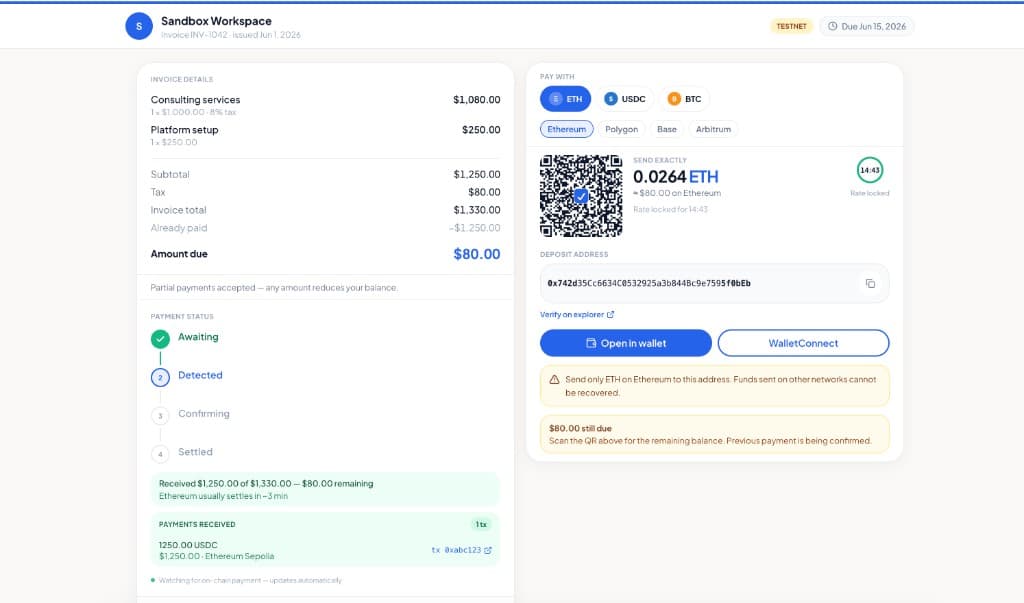
I run product at Settlematic, where invoice-scoped addresses are part of the non-custodial design, so this is biased but the reasoning is general.
The problem with one shared address
If every client pays into the same wallet address, you've collapsed all your receivables into one stream. At reconciliation time you face a list of incoming transfers with no inherent link to invoices or clients — you're matching amounts and dates by hand, hoping two clients didn't pay similar amounts on the same day. Address reuse also has privacy and traceability downsides, since everything you receive is visible against one address.
What invoice-scoped addresses change
Generate a fresh address per invoice and the picture inverts. A payment to that address can only belong to that invoice and that client. Reconciliation stops being inference and becomes a direct mapping:
- Unambiguous matching. One address, one invoice — no guessing which transfer paid which job.
- Cleaner reconciliation. This is what lets month-end be a review rather than an Etherscan sprint. See reconciling crypto payments.
- Better privacy. You're not concentrating all activity against a single reused address.
- Partial-payment clarity. Multiple payments to the invoice's address tie to that invoice's balance. (Partial payments.)
How it fits non-custodial settlement
Invoice-scoped addresses are the front end of a non-custodial flow: the platform derives the address, detects the payment on-chain, and sweeps it to a destination wallet you control. The per-invoice address makes the detection and mapping clean; the sweep keeps custody with you. Together they turn on-chain payments into something that behaves like proper accounts receivable. (Treasury & sweeps.)
Why this is "boring infrastructure" that matters
Invoice-scoped addressing isn't a flashy feature, but it's the quiet reason your books stay clean. The teams that struggle with crypto reconciliation are almost always the ones sharing one address; the teams that close in minutes are using per-invoice addresses, whether they think about it or not. It's worth checking that any platform you evaluate does this rather than pooling payments.
The bottom line
Invoice-scoped wallet addresses are a small design decision that makes crypto payments reconcilable, more private, and clean to audit. It's the structural reason invoicing platforms beat a shared wallet for accounts receivable. Run a free testnet invoice to see per-invoice addressing and the sweep in action.
Explore Settlematic
Ready to try the workflow in your own workspace? Start on testnet, then explore our how it works guide and product features.