How to Detect On-Chain Invoice Payments Automatically (2026)
How automatic on-chain payment detection works for crypto invoices in 2026 — invoice-scoped addresses, confirmations, partial payments, and why it beats manual checking.
TL;DR
Automatic detection means the platform watches the blockchain for payments to each invoice's address, confirms them, and updates the invoice status without you checking a block explorer. It rests on invoice-scoped addresses, confirmation thresholds, and partial-payment logic — and it's what turns crypto into hands-off accounts receivable. Here's how it works and why it matters.
I run product at Settlematic, so this reflects how we built detection; the concepts are general.
The problem manual checking creates
Without automatic detection, confirming a crypto payment means someone opens a block explorer, finds the transaction, checks the amount, and manually marks the invoice paid. That doesn't scale past a handful of invoices, it's error-prone, and it delays anything that should happen on payment. Automatic detection removes the human from the loop: the system knows the moment a payment lands and acts on it.
How automatic detection works
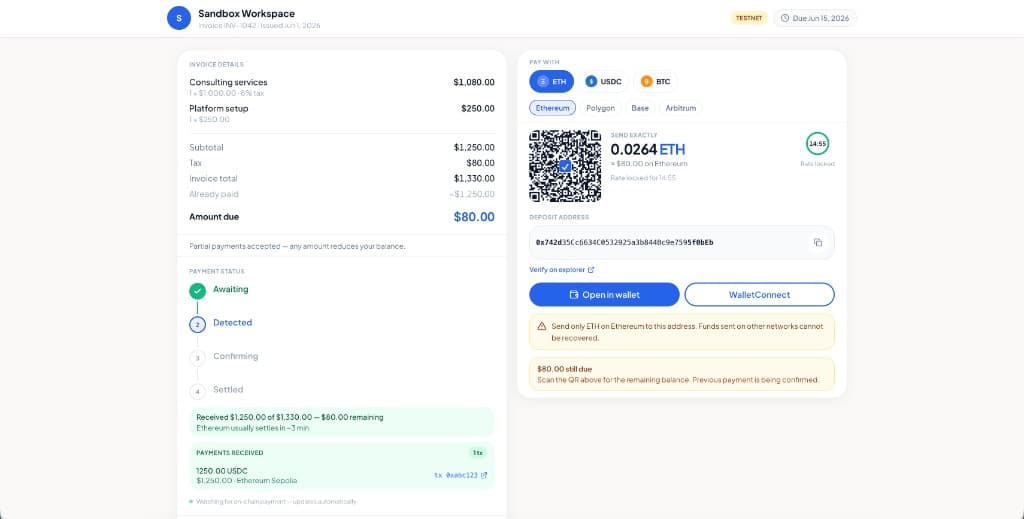
- Invoice-scoped address. Each invoice gets a unique deposit address, so any payment to it belongs unambiguously to that invoice. This is the foundation — see invoice-scoped wallet addresses.
- Chain monitoring. The platform watches that address across the relevant network for incoming transfers.
- Confirmation threshold. A payment isn't treated as final the instant it appears; the platform waits for enough confirmations to be confident it won't be reversed, then marks it confirmed.
- Status update. The invoice moves to PAID or PARTIALLY_PAID, and any subscribed webhooks fire so your systems react.
- Sweep. On a non-custodial platform, confirmed funds sweep to a wallet you control.
Why confirmations matter
A transaction appearing in the mempool or in a fresh block isn't the same as a settled one — chains can reorganize. Waiting for a confirmation threshold is how detection avoids treating a not-yet-final payment as done. The right threshold balances speed against certainty, and it's why "detected" and "confirmed" are distinct states. Building this yourself is non-trivial, which is a big part of why platforms exist rather than everyone rolling their own watcher.
Partial payments and overpayments
Good detection handles the messy cases: a client underpays slightly after network fees, pays in two tranches, or overpays. The system should attribute each payment to the invoice, update the running balance, and apply status logic — PARTIALLY_PAID until the balance closes — rather than generating a support ticket for every few-dollar discrepancy. See partial payments.
Why this is the quiet core of crypto invoicing
Automatic detection isn't a headline feature, but it's what makes everything else work: reconciliation stays clean because each payment maps to an invoice; webhooks can fire because the system knows when payment happened; and you never touch a block explorer in the normal flow. When evaluating a platform, confirm detection is automatic and handles partials and confirmations properly — manual marking is a red flag at any scale.
The bottom line
Automatic on-chain detection — built on invoice-scoped addresses, confirmation thresholds, and partial-payment logic — is what turns crypto payments into hands-off receivables. It's the difference between a platform and a spreadsheet next to a block explorer. Run a free testnet invoice and watch detection, status updates, and the sweep happen automatically.
Explore Settlematic
Ready to try the workflow in your own workspace? Start on testnet, then explore our how it works guide and product features.