Crypto Invoicing for DAOs and On-Chain Vendors (2026)
How DAOs and their vendors handle invoicing in 2026 — on-chain payment workflows, traditional invoice UX for off-chain contributors, records, and choosing the right approach.
TL;DR
DAOs pay contributors and vendors on-chain, often in stablecoins, with treasury controlled by multisig and governance. The invoicing question splits two ways: on-chain-native workflows for participants already in the ecosystem, and traditional invoice UX with clean records for off-chain vendors and anyone who needs to satisfy an accountant. Here's how to think about it.
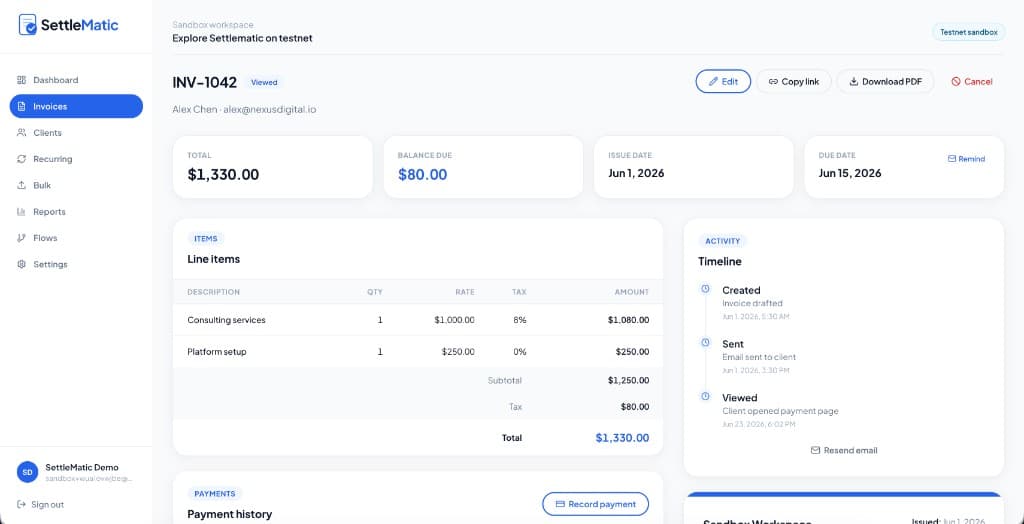
I run product at Settlematic, so this is biased — and for DAO-internal flows, a network-native tool is often the better fit, which I'll say plainly.
The DAO invoicing split
A DAO's payment relationships aren't uniform. On one side are on-chain-native contributors and vendors who already operate in a specific payments network and expect on-chain payment requests. On the other are off-chain vendors — agencies, contractors, service firms — who expect a traditional invoice PDF their own accountant will accept. A single approach rarely serves both well, so the real decision is matching the tool to the counterparty.
For on-chain-native counterparties
Where both the DAO and the vendor already use the same payments network, network-native tools shine: shared rails, directories of crypto-friendly counterparties, and low friction because both sides speak the same protocol. Request Finance, built on the Request Network, is a common default here for exactly this reason. If your vendor graph is dense inside one network, that network effect is hard to beat. We're fair about this in Request Finance alternatives.
For off-chain vendors
When the DAO pays an agency or contractor who runs traditional books, the on-chain "payment request" model can clash with what their accountant expects. Here, invoicing-first tools that produce fiat-denominated, line-itemed, branded invoices — with clean exports — reduce friction. The vendor gets a document their finance team recognizes; the DAO gets a record that maps payment to deliverable. Treasury still settles on-chain; the difference is the record and the UX wrapped around it.
Records and transparency
DAOs care about transparent, auditable records by nature. Invoice-scoped addresses, fiat-at-payment values, and exportable histories support that — each payment maps to an invoice and a counterparty, which is exactly the kind of record governance and community reporting benefit from. Non-custodial settlement also aligns with DAO norms: funds route to wallets the DAO controls, not a platform balance. (Custody comparison.)
The practical recommendation
Map your counterparties before you pick a tool. For dense on-chain-native vendor graphs, lean network-native. For off-chain vendors who need traditional invoice UX and records, lean invoicing-first. Many DAOs end up using more than one, matched to the relationship. The full landscape is in the buyer's guide.
If you want to see the invoicing-first, non-custodial flow for off-chain vendor payments, you can run a free testnet invoice.
Explore Settlematic
Ready to try the workflow in your own workspace? Start on testnet, then explore our how it works guide and product features.