Best Crypto Invoicing for Freelancers (2026 Guide)
A practical guide to crypto invoicing for freelancers in 2026 — how to invoice in fiat, get paid in USDC or ETH, stay non-custodial, and keep records your accountant accepts.
TL;DR
Freelancers don't need a custodial exchange or a raw wallet address to get paid in crypto. The right setup lets you quote in USD, EUR, or GBP, accept USDC or ETH across chains, keep funds in a wallet you control, and produce a record your accountant won't reject. This guide covers what to look for, the trade-offs, and where simple payment links stop being enough.
I lead product at Settlematic, so treat this as an informed-but-biased view. Where a simpler free tool is the better call for your stage, I say so.
Why freelancers reach for crypto invoicing at all
Most freelancers don't start out wanting "crypto invoicing." They start out with one client who pays in USDC, a wallet address pasted into an email, and a spreadsheet. That works until three things happen at once: you have more than a couple of crypto-paying clients, you need to show income for tax or a visa or a loan, and you can no longer remember which transaction settled which job.
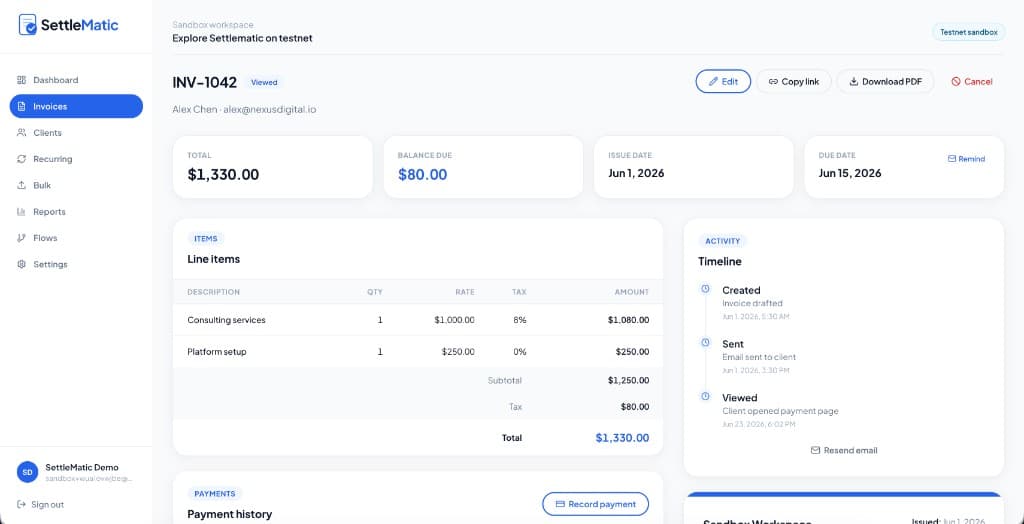
At that point you're doing accounts receivable, just without the tools. A crypto invoice fixes the gap by attaching an invoice number, a fiat-denominated amount, line items, and a status to each payment — so a wallet transfer becomes a record instead of a mystery entry on a block explorer.
What "good" looks like for a solo operator
The needs of a freelancer differ from an agency or a SaaS finance team. You want speed and clarity, not a procurement checklist. The features that actually matter at this stage:
- Fiat-denominated invoices. You agreed a price in dollars; the invoice should say dollars and convert to crypto at payment time. Quoting raw ETH amounts invites disputes when the price moves between sending and paying.
- A hosted payment page. One link your client opens, picks an asset and network, sees a fiat-quoted amount and a QR code, and pays. No wallet-address copy-paste, which is where wrong-chain mistakes happen.
- Non-custodial settlement. Funds should land in a wallet you control, not sit on a platform's balance sheet. For a solo operator with no treasury team, counterparty risk is not worth taking on for the sake of convenience.
- A branded PDF. Clients — and their accountants — still expect an invoice document with your name, the line items, and terms.
- Clean export. A CSV with invoice numbers and amounts you can hand to a bookkeeper or import into accounting software.
If a tool gives you a payment link but no invoice number, no status, and no export, it's a donate button with extra steps. That's fine for tips. It's not fine for client work.
When a free payment link is genuinely enough
Honest answer: if you have one occasional crypto client and your crypto income is a rounding error against your fiat work, you do not need a platform yet. A simple payment link or a manually tracked wallet address is rational. The switching cost is lowest before you accumulate several quarters of explorer-based reconciliation debt — so the trigger to upgrade is when your accountant first complains, or when you can't answer "which job was this payment for?" without scrolling Etherscan.
We wrote a fuller breakdown of where links break down in why crypto invoicing beats generic payment links.
The custody question, kept simple
This is the one decision worth slowing down for. Custodial platforms hold your funds in their wallets until you withdraw. That can feel convenient, but it means a platform policy change, a withdrawal delay, or a counterparty event sits between you and your money. Non-custodial platforms derive a unique deposit address per invoice, detect the payment on-chain, and sweep it to a wallet you label and control — the platform orchestrates the movement but never holds your keys.
For a freelancer, the non-custodial model removes an entire category of risk you have no team to manage. We go deeper in what is non-custodial [crypto invoicing](/blog/what-is-non-custodial-crypto-invoicing) and in our treasury and sweeps overview.
Getting paid across chains without the headaches
Your clients won't all pay the same way. One sends USDC on Ethereum, another USDT on Tron because the fees are lower, a third holds ETH. A good freelance setup lets you accept several assets across several networks on a single invoice — and ideally handles partial payments, so a client can pay half now and half on delivery without you re-issuing anything. Settlematic supports ETH, BTC, SOL, USDC, and USDT across Ethereum, Polygon, Bitcoin, Solana, and Tron, with partial payments across different assets on one invoice.
The practical tip: switch on testnet first. Send yourself a test invoice, pay it from a test wallet, and watch the status change before you ever put a real client through the flow. It takes ten minutes and saves the support headache of a client paying on the wrong network.
Keeping records your accountant will accept
Crypto income is still income. Most jurisdictions treat a crypto payment as ordinary revenue at its fiat value on the day received, and may treat any later change in the coin's value as a separate gain or loss when you convert or spend it. The specifics vary by country, and this isn't tax advice — but the implication for tooling is universal: you need the fiat value at time of payment, the date, and an invoice reference, all in one export. That's exactly what an invoicing platform records and a bare wallet does not.
For the deeper version of this, see our practitioner's guide to crypto invoicing with built-in tax reporting.
A simple starting setup
If you're a freelancer moving off pasted wallet addresses this week:
- Create a free account and set your invoice currency to the fiat you quote in.
- Configure one destination wallet you control for sweeps.
- Send yourself a testnet invoice and pay it to confirm the flow.
- Issue your next real invoice through the platform instead of by email.
- Export the CSV at month-end and hand it to whoever does your books.
That's the whole on-ramp. You keep the crypto-payment convenience your clients like, and you stop reconstructing your own revenue from a block explorer.
The honest summary
For freelancers, the best crypto invoicing tool is the one that turns a wallet transfer into a real invoice record, keeps your funds in your own wallet, and exports cleanly — without making you learn finance-team tooling you don't need. If you're past the one-client stage, that's worth setting up now rather than at tax time.
You can run a testnet invoice in about fifteen minutes to see whether the flow fits how you work.
Explore Settlematic
Ready to try the workflow in your own workspace? Start on testnet, then explore our how it works guide and product features.