Best Crypto Invoicing for Agencies (2026 Guide)
How agencies should evaluate crypto invoicing in 2026 — milestone billing, partial multi-asset payments, tax exports, non-custodial sweeps, and clean month-end close.
TL;DR
Agencies have requirements freelancers don't — milestone billing, partial payments across assets, retainer recurring, branded PDFs for enterprise clients, and a month-end close that doesn't require a reconciliation sprint. The right crypto invoicing setup preserves the convenience clients like while producing finance-grade records. This guide is the evaluation framework, written from the inside.
I run product at Settlematic, so I state the bias up front. Where a competitor fits a specific agency profile better, I'll say it.
The agency problem is reconciliation, not acceptance
Accepting crypto is the easy part — any wallet does that. The pain for an agency shows up at quarter-end, when finance has to reconstruct which on-chain transfer paid which milestone on which statement of work, across multiple clients paying in different assets on different chains. By the time you're billing $20k+ SOWs, a binary "paid / unpaid" payment link can't represent how the work actually gets paid for.
So the right question for an agency isn't "can this tool accept USDC?" It's "can this tool produce a record my controller can close the books with?"
The five things that actually matter for an agency
After the sales-demo gloss wears off, these are the criteria that decide whether a platform survives contact with real agency billing:
- Partial payments across assets. Enterprise clients pay milestone tranches. One pays the first milestone in USDC, the second in ETH. The platform must represent a single invoice moving through PARTIALLY_PAID states — not force you to re-issue. This is the single most common place tools fall short. See why partial payments solve two problems.
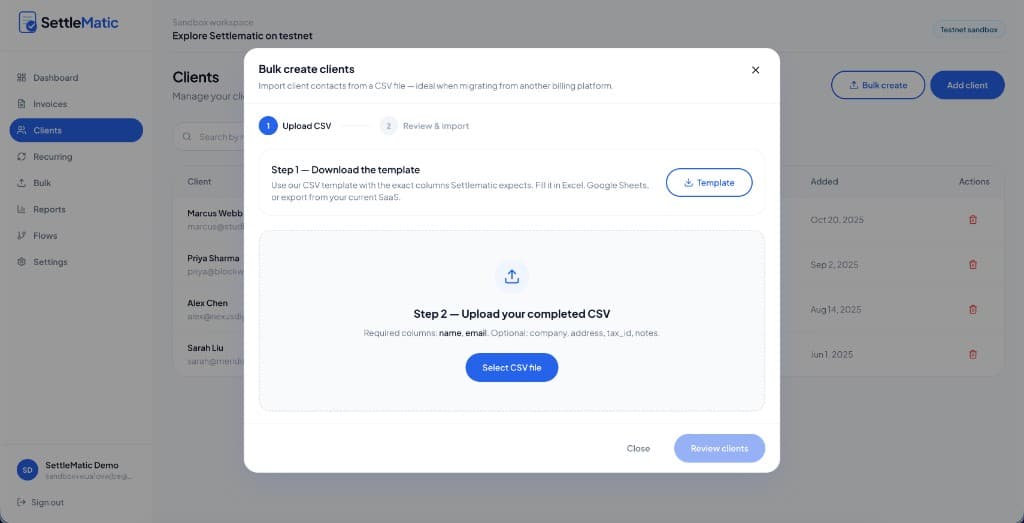
- Recurring billing for retainers. Most agencies have monthly retainers. Recurring schedules turn that into automation instead of a manual re-send every month. (Clients & recurring billing.)
- Branded, line-itemed PDFs. Your accounts-payable contact at a client's finance department still wants a PDF with line items, terms, and your branding. "Send funds to this address" does not pass their AP process.
- Tax-ready exports. A CSV with invoice numbers, fiat values at time of payment, and tax buckets — exported by the early business days of the month, not reconstructed from Etherscan over two days. (Reporting & exports.)
- Non-custodial sweeps. Agency cash flow shouldn't sit on a platform's balance. Funds should sweep to wallets you control, ideally with percentage splits so you can route to operating and reserve wallets automatically.
Why custody is a treasury decision, not a convenience one
For an agency, the custody model determines where your working capital sits if your billing vendor has a bad week. Custodial platforms aggregate merchant flows into operator-controlled wallets; non-custodial platforms derive invoice-scoped addresses and sweep to destinations you label, often with a cooldown window on destination changes to reduce account-takeover risk.
The architecture choice doesn't remove your own obligations — securing keys, enforcing 2FA on billing admin accounts, training staff against phishing — but it does decide who controls the funds in the window between payment and withdrawal. We cover the full comparison in custodial vs non-custodial [crypto invoicing](/blog/custodial-vs-non-custodial-crypto-invoicing).
Milestone billing, concretely
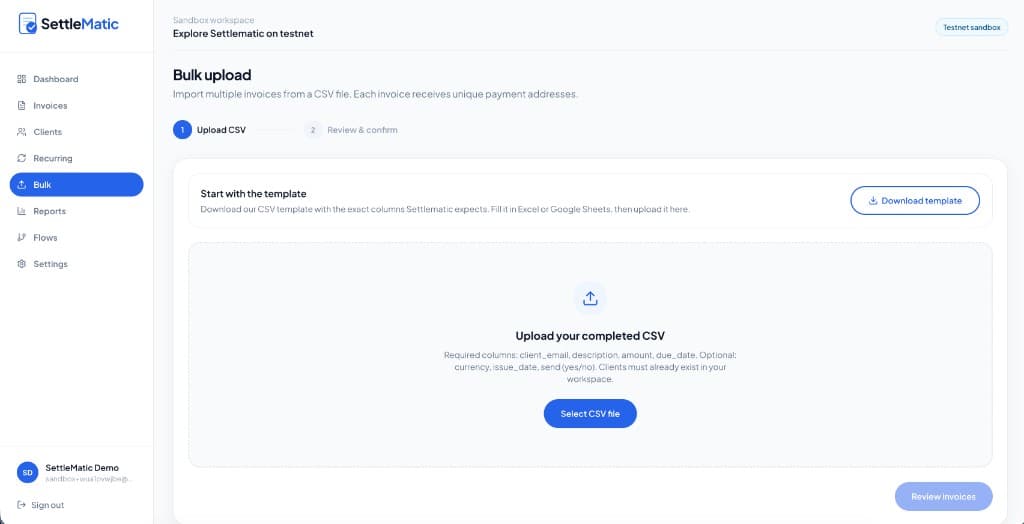
The agency-specific workflow that breaks most tools is deliverable-gated payment. A $60k SOW paid in three $20k milestones, where each milestone might settle in a different asset, and where a 2% underpayment after network fees shouldn't trigger a support ticket. What you want to see in a demo:
- Issue one invoice for the SOW.
- Client pays milestone one in USDC — invoice moves to PARTIALLY_PAID, balance updates.
- Client pays milestone two in ETH — same invoice, balance updates again.
- Underpayment of a few dollars after gas is handled by status logic, not a human.
- The export shows the full payment history against one invoice number.
If a vendor can't show you that exact flow live, assume it's roadmap, not reality. We put the seven questions to ask in every vendor demo in the buyer's guide for this reason.
Realistic rollout for an agency
A fifty-invoice-a-month agency should plan two to four weeks, not two days, to go live properly:
- Week 1: chart-of-accounts mapping, tax jurisdiction configuration, branding and PDF templates.
- Week 2: testnet invoices with internal wallets, a partial-payment drill, a webhook consumer in staging if you sync to a data warehouse.
- Week 3: pilot with two friendly clients on mainnet at low amounts.
- Week 4: migrate open receivables, train support on the status vocabulary (SENT, VIEWED, PARTIALLY_PAID, PAID, OVERDUE).
The teams that skip testnet to "save time" usually pay for it with a support weekend when someone sends funds on the wrong chain. The week you spend on sandbox flows is the cheapest insurance you'll buy.
Where competitors fit better
To be fair about it: if your agency operates inside a Web3 ecosystem where both you and your clients already use Request Finance, its network effects can lower friction more than a newer platform. If you're a Bitcoin-only shop with strong engineers who want zero vendor dependency, BTCPay Server remains compelling despite the DevOps cost. The non-custodial, invoicing-first, multi-asset approach is strongest for agencies billing multi-chain clients who need finance-grade records — not for every profile. We lay out the full landscape in the independent buyer's guide and the Request Finance alternatives comparison.
The bottom line for agencies
Pick the tool by the export and the partial-payment flow, not the homepage hero. The convenience your clients feel at checkout matters, but what protects your margin is the record that survives crypto reality at month-end. Run the same pilot invoice on your two finalists with a real client willing to pay a small test amount — the winner reveals itself in the reconciliation, every time.
You can start a free workspace and run a testnet milestone invoice to test the partial-payment flow against your own SOW structure.
Explore Settlematic
Ready to try the workflow in your own workspace? Start on testnet, then explore our how it works guide and product features.