Crypto Invoicing for Accountants: What Your Bookkeeper Actually Needs (2026)
A practical guide for accountants and bookkeepers handling crypto invoices in 2026 — the records, exports, and fiat-at-payment data needed to close books and file cleanly.
TL;DR
Accountants don't need crypto to be simple — they need it to be recorded. The data that makes crypto invoices bookable is the same data a traditional invoice carries plus the fiat value at time of payment and a transaction reference. Give your bookkeeper that, in a clean export, and crypto stops being a special case. Here's the checklist.
I run product at Settlematic, so this is the records-and-export view from the platform side. It's general information, not accounting advice.
What makes a crypto invoice "bookable"
A bookkeeper closing the period needs each payment to answer: who paid, for what, how much in fiat, when, and which invoice. A traditional invoice supplies most of that. The crypto-specific additions are:
- Fiat value at time of payment — so revenue is recorded in the books' base currency, not a coin amount.
- Transaction reference — the on-chain identifier, for audit traceability.
- Asset and network — what was received and where.
When those are attached to the invoice number, a crypto payment journals like any other receipt. When they're missing, the bookkeeper is reconstructing fiat values from price history — slow and error-prone.
The export an accountant wants
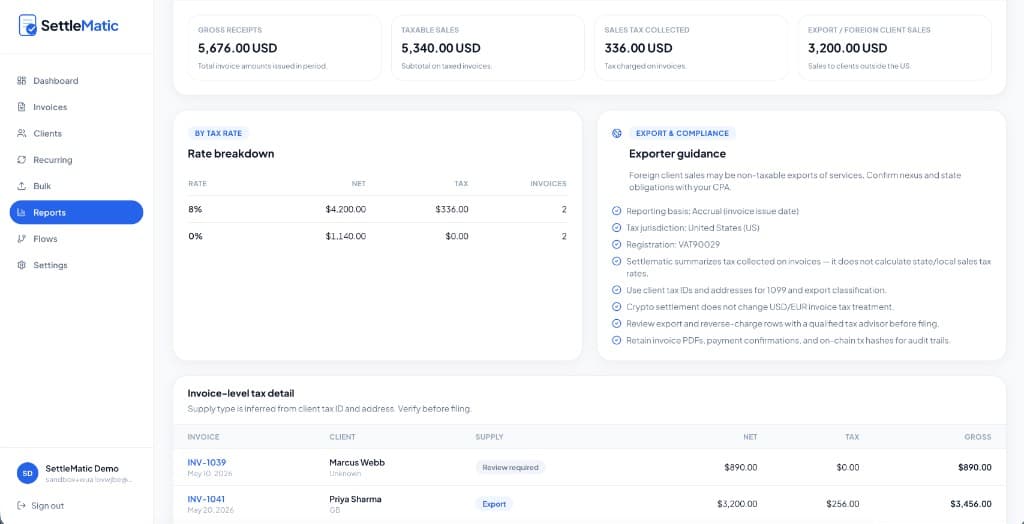
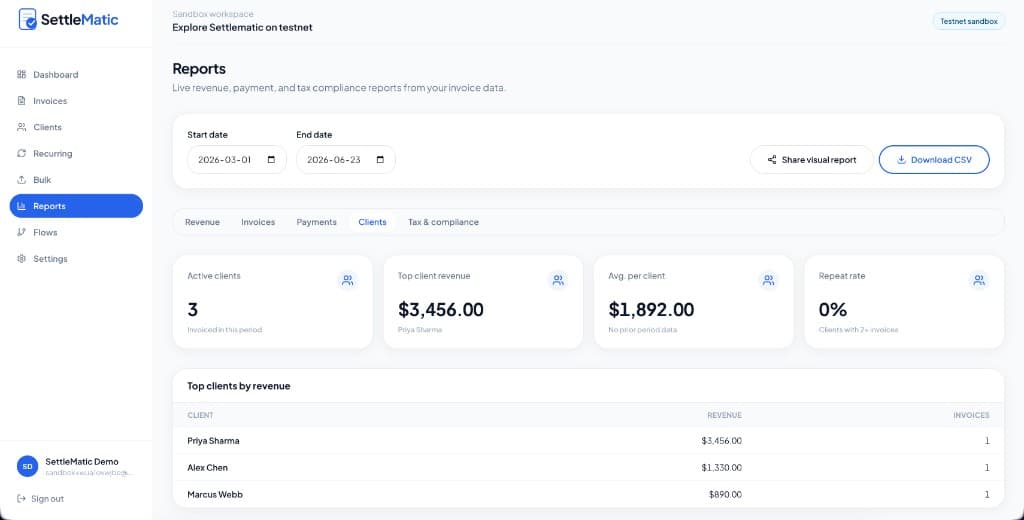
The deliverable that makes an accountant's life easy is a CSV with one row per payment containing: invoice number, client, date, asset, amount, fiat value at payment, and transaction reference. With that, mapping to the chart of accounts is mechanical. Without invoice numbers, exports become wallet CSVs that don't tie to receivables — a known red flag in crypto tooling. (Reporting & exports.)
Handling the crypto-specific events
Two things accountants should watch:
- Income at receipt. Generally recognized at fiat value when received. The platform capturing this at payment time removes guesswork.
- Gain/loss on disposal. If the business holds volatile crypto and later converts or spends it, there may be a separate gain or loss from the value at receipt. Stablecoins minimize this. Treatment is jurisdiction-specific — apply local rules.
We cover the records flow in the tax reporting guide and the close process in month-end reconciliation.
Advice for accountants onboarding a crypto-paying client
- Insist on invoice-scoped records, not a shared wallet history. One address per invoice makes everything traceable.
- Require fiat-at-payment in the export. It's the field that saves the most time.
- Reconcile monthly. It keeps the dataset small and the values fresh.
- Separate stablecoin and volatile-asset flows mentally — the gain/loss exposure differs.
The bottom line
Crypto invoicing is accountant-friendly when the platform records fiat-at-payment and exports with invoice numbers and transaction references. That's the whole ask. If a client's tool can't produce that, the friction lands on the bookkeeper. To see the export format, run a free testnet invoice.
Explore Settlematic
Ready to try the workflow in your own workspace? Start on testnet, then explore our how it works guide and product features.