Best USDC Invoicing Tools for B2B (2026)
What B2B teams should look for in USDC invoicing in 2026 — fiat-denominated invoices, multi-chain USDC acceptance, partial payments, tax exports, and non-custodial settlement.
TL;DR
USDC is a strong fit for B2B because it's dollar-referenced — the amount paid maps cleanly to the invoice without volatility. For business invoicing you want fiat-denominated invoices, USDC acceptance across the chains your clients use, partial-payment support, clean tax exports, and non-custodial settlement. Here's how to choose.
I run product at Settlematic, so this is biased but the criteria are general.
Why USDC suits B2B invoicing
In B2B, predictability matters more than novelty. USDC tracks the dollar, so a $10,000 invoice paid in USDC settles at roughly $10,000 of value — no "the price moved" reconciliation headache, no gain/loss volatility on the payment itself. That stability is why many finance teams prefer stablecoins over volatile assets for receivables, even when they're comfortable holding crypto.
What to look for
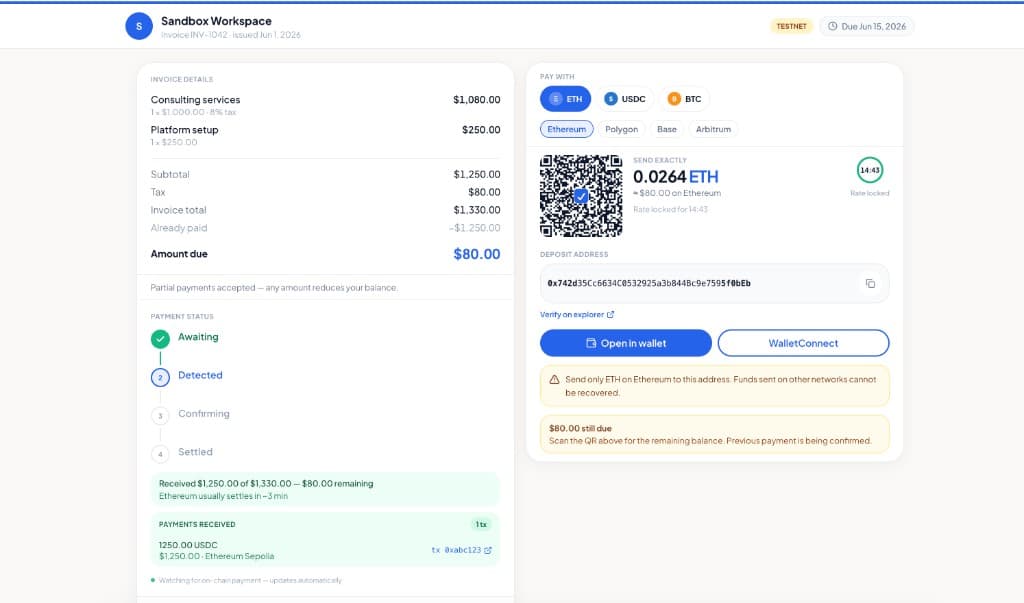
- Fiat-denominated invoices with line items, tax, terms, and branded PDFs — your client's accounts-payable team expects a proper invoice, not a payment request.
- Multi-chain USDC acceptance. USDC lives on several chains; accept it where your clients hold it (Ethereum, Polygon, Solana, and others). See accepting stablecoins across chains.
- Partial payments. B2B invoices get paid in tranches; one invoice should accept multiple USDC payments and track the balance. (Partial payments.)
- Tax-ready exports. Invoice numbers, fiat values, and tax buckets in a CSV your bookkeeper can import.
- Non-custodial sweeps to wallets you control, so your receivables aren't sitting on a platform balance. (Custody comparison.)
The AP-team test
The detail that separates a B2B-ready tool from a consumer checkout: can you hand your client's accounts-payable contact a branded PDF with line items and terms, and a single hosted link to pay? AP departments process invoices, not wallet addresses. If your tool can't produce the document and the link, it'll create friction on every enterprise payment.
Where USDC invoicing fits in your stack
USDC invoicing doesn't replace your accounting system — it feeds it. The invoicing tool handles creation, checkout, detection, and settlement; the export carries clean records into your books. Treat it as the receivables front end, not a full ERP. The buyer's guide covers where invoicing-first tools stop and accounting begins.
The bottom line
For B2B USDC invoicing, choose on the invoice document quality, multi-chain acceptance, partial-payment handling, and export — then verify the non-custodial claim. Run a free testnet USDC invoice and check the PDF and export against what your client's AP team and your bookkeeper need.
Explore Settlematic
Ready to try the workflow in your own workspace? Start on testnet, then explore our how it works guide and product features.