Request Finance Alternatives for 2026: An Honest Comparison
Looking for a Request Finance alternative in 2026? A fair comparison of options across non-custodial settlement, partial multi-asset payments, tax exports, and who each fits.
TL;DR
Request Finance is strong when you and your counterparties already live inside the Request Network ecosystem. If you're outside it — billing clients who expect traditional invoice PDFs, needing finance-grade partial payments, or wanting non-custodial sweeps with cleaner tax exports — there are alternatives worth comparing. This guide is fair to Request and clear about where each option fits.
Disclosure: I run product at Settlematic, one of the alternatives below. I'll state where Request or another tool is the better choice for a given profile, because a comparison that only flatters the author isn't useful to a procurement decision.
What Request Finance is good at
Request Finance, built on the Request Network, is a popular choice for DAOs and crypto-native vendors already embedded in that ecosystem. It emphasizes payable and receivable flows with on-chain payment requests, multi-currency support, and a large directory of crypto-friendly counterparties. When both sides of a transaction already use Request, friction is low and the network effects are real.
So the honest framing isn't "Request is bad." It's: Request is built around a network. If your vendor and client graph is inside that network, it's hard to beat. If it isn't, the model can feel closer to a "payment request" than the traditional invoice PDF your off-chain clients expect — and that mismatch is usually why people start looking for an alternative.
Why teams look for an alternative
The common triggers, in practice:
- Off-chain clients. Your accounts-payable contact at a client's finance department wants a branded PDF with line items and terms, not an on-chain payment request mental model.
- Partial-payment depth. You need a single invoice to move through PARTIALLY_PAID states across multiple assets, not a binary paid/unpaid request.
- Custody and treasury control. You want funds swept to wallets you control with configurable routing.
- Tax-export quality. Your accountant wants invoice numbers, fiat-at-time-of-payment values, and tax buckets in one clean CSV.
If none of those is a pain point, you may not need to switch. If two or more are, a comparison is worth your time.
The alternatives, and who each fits
Settlematic — invoicing-first, non-custodial, multi-asset
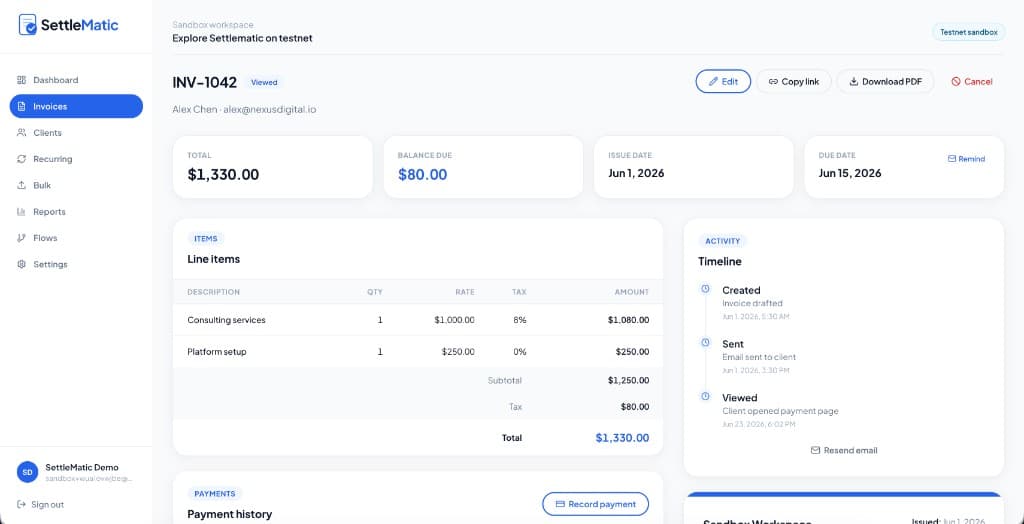
The closest fit for teams that want QuickBooks-shaped billing semantics with crypto settlement and traditional-invoice UX for off-chain clients. Invoices are fiat-denominated (USD, EUR, GBP) with per-line tax, terms, and branded PDFs. Clients pay via a hosted page supporting ETH, BTC, SOL, USDC, and USDT across Ethereum, Polygon, Bitcoin, Solana, and Tron — including partial payments across different assets on one invoice. Treasury is non-custodial: unique deposit addresses per invoice, on-chain detection, and sweeps to wallets you control.
- Best for: agencies, SaaS, and services firms billing multi-chain clients who need finance-grade records and traditional invoice UX.
- Trade-off: newer brand than decade-old processors; you still configure tax jurisdiction fields correctly.
Gilded — treasury-operator focus
Gilded has long served crypto companies managing operational invoices and treasury activity, combining invoicing with wallet tracking and accounting-oriented views. Teams already running Gilded treasury workflows often extend into invoicing rather than switching stacks.
- Best for: crypto-first operators who live in both fiat books and on-chain wallets.
- Trade-off: evaluate how checkout presents to non-crypto-native clients who expect a card-like experience.
BitPay — processor heritage, custodial leaning
BitPay built its brand in Bitcoin merchant processing. Invoicing exists alongside payment processing and often implies a custodial settlement model — funds flow through BitPay's infrastructure before withdrawal.
- Best for: BTC-leaning merchants who want one established relationship and accept custody trade-offs.
- Trade-off: multi-asset and partial-payment semantics may be narrower than invoicing-first platforms.
BTCPay Server — self-hosted sovereignty
Open-source, self-hosted, and favored by Bitcoin-focused and privacy-conscious merchants. You run the server, you control the keys, you extend via plugins.
- Best for: technically strong teams that want zero vendor dependency and primarily Bitcoin/Lightning flows.
- Trade-off: total cost of ownership is real — DevOps, backups, upgrades, and on-call when checkout breaks mid-payment.
Coinbase Commerce / Stripe crypto — familiar brands, narrower depth
These appeal to teams optimizing for brand trust and quick setup, and work for straightforward checkout. Finance-grade receivables — cross-chain partial payments, recurring retainers with aging, jurisdiction-specific tax buckets — are typically not the design center.
- Best for: experimental crypto volume where a simple checkout is enough.
- Trade-off: many teams hit reconciliation pain at month-end and migrate to invoicing-first tools.
How to choose without guessing
Don't pick on a feature grid alone. Run the same pilot invoice on your two finalists with a real client willing to pay a small test amount, and watch two things: the partial-payment flow (pay in two assets, confirm one invoice updates correctly) and the export (does the CSV give your accountant invoice numbers and fiat values without manual tx-hash copy-paste?). The winner shows up in the exports, not the homepage copy. The full evaluation framework is in our independent buyer's guide.
The bottom line
If you're already inside the Request Network and your counterparties are too, Request Finance is hard to beat on friction. If you're billing off-chain clients, need finance-grade partial payments, or want non-custodial treasury control, the invoicing-first alternatives are worth a side-by-side. You can run a free testnet invoice to test the flow against your own client structure before committing.
Explore Settlematic
Ready to try the workflow in your own workspace? Start on testnet, then explore our how it works guide and product features.