What Is a Crypto Invoice and How Does It Work? (2026)
A plain-English 2026 explainer on crypto invoices — what they are, how they differ from a wallet address or payment link, the payment flow, and when a business needs one.
TL;DR
A crypto invoice is a normal invoice — a request for payment with an amount, line items, and terms — that's settled in cryptocurrency instead of a bank transfer or card. The amount is usually quoted in fiat (like USD) and paid in crypto (like USDC) at the time of payment. The difference from a bare wallet address is that an invoice carries a number, a status, and a record. Here's how it works.
I run product at Settlematic, so this is biased but the explanation is general.
The plain definition
You already know what an invoice is: a document that says "you owe me this amount for these things, due by this date." A crypto invoice is the same document, with one change — the payment settles on a blockchain in crypto rather than through a bank. Critically, a good crypto invoice is still denominated in fiat: it says $2,000, and the client pays $2,000 worth of crypto at the moment they pay. The crypto is the rail; the dollar figure is the agreement.
How it differs from a wallet address or payment link
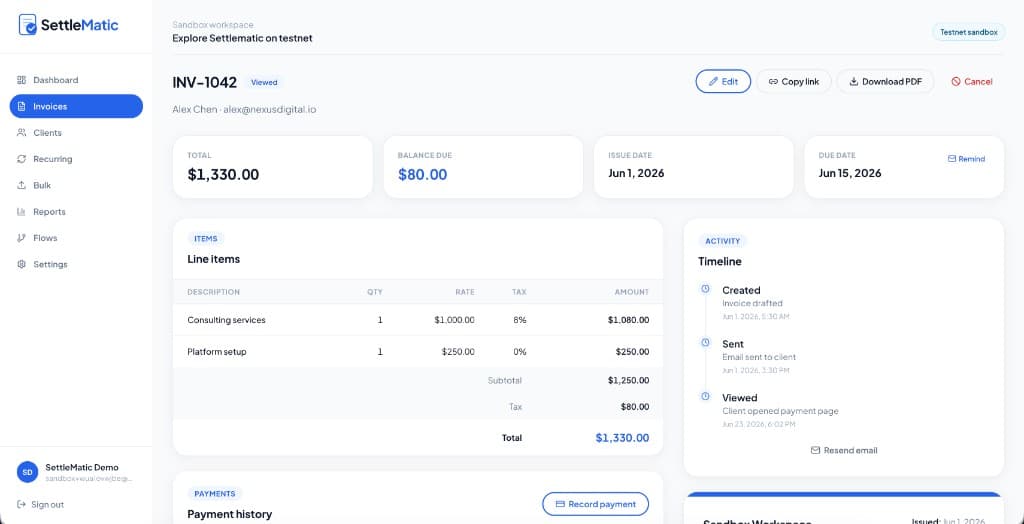
Pasting a wallet address into an email gets you paid, but it isn't an invoice — there's no invoice number, no line items, no status, no record tying the payment to a job. A crypto invoice adds the structure that makes it accounts receivable rather than a transfer:
- An invoice number and client.
- Line items, terms, and often a branded PDF.
- A status (sent, viewed, paid, partially paid, overdue).
- A record with the fiat value at payment for your books.
That's the difference between something your accountant can use and something you have to decode from a block explorer later. We go deeper in why [crypto invoicing beats payment links](/blog/why-crypto-invoicing-beats-payment-links).
How the payment flow works
- You create the invoice, denominated in fiat, with line items and the assets you'll accept.
- The client opens a hosted payment page, picks an asset and network, and sees the exact crypto amount due plus a QR code.
- They pay from their wallet; the platform detects the on-chain payment and updates the invoice status.
- On a non-custodial platform, the funds sweep to a wallet you control.
From the client's side it's one link and a wallet confirmation. From yours, it's a tracked, recorded receivable.
When a business needs one
If you have accounts receivable — recurring clients, partial deliverables, tax obligations, a need to show income — you're past the wallet-address stage and a crypto invoice earns its place. If you just take the occasional one-off payment, a simple link may still be enough for now.
The bottom line
A crypto invoice is a regular invoice settled in crypto, denominated in fiat, carrying the structure and records a bare wallet can't. If you have receivables, it's the right tool. Run a free testnet invoice to see one end to end.
Explore Settlematic
Ready to try the workflow in your own workspace? Start on testnet, then explore our how it works guide and product features.
Frequently asked questions
- Is a crypto invoice paid in crypto or fiat?
- The amount is usually quoted in fiat and paid in crypto, calculated at the time of payment. So you agree a dollar figure and receive its crypto equivalent.
- Do I need a crypto wallet to send one?
- You need a destination wallet for funds to land in. The client needs a wallet to pay from. The invoice itself is created in the platform.
- How is a crypto invoice different from a regular invoice?
- Mostly just the settlement rail. It carries the same invoice structure but is paid on-chain, and good ones record the fiat value at payment for your books.