Custom Branding in Crypto Invoicing: Why Most Platforms Stop at a Logo
Most crypto invoicing tools stop at a logo. This 2026 comparison maps Request Finance, Acctual, BitPay, Coinbase, and white-label gateways on logo, color theming, and custom pay domains — and where full branding lives inside invoicing vs reseller tiers.
TL;DR
Crypto invoicing platforms typically offer logo-on-invoice only. Full white-label branding — logo, colors, and your own domain on the hosted payment page — historically lived in separate gateway reseller tiers at $500–$1,000+/month. Settlematic bundles all three branding layers into the invoicing product itself.
*Last verified: June 2026*
Crypto invoicing platforms (Request Finance, Gilded, Acctual, CoinRemitter) typically let you add a logo to an invoice — and that is it. Full white-label branding (logo + brand colors + your own domain on the actual hosted payment page) exists, but historically only inside a different product category: white-label crypto payment gateways (CoinGate, Plisio, NOWPayments, OxaPay), usually sold as a $500–$1,000+/month reseller add-on aimed at payment service providers, not at a business that just wants to send invoices. Coinbase Commerce and BitPay, the two best-known checkout brands, never offered custom domains at all. Settlematic builds all three branding layers — logo, color theming, and custom domain — directly into the invoicing product itself, with no separate reseller tier required.
Why this question matters right now
On March 31, 2026, Coinbase shut down Coinbase Commerce for every merchant outside the US and Singapore, folding the product into a new custodial platform called Coinbase Business. For merchants who built a crypto checkout flow on Commerce, the migration was disruptive enough that Coinbase's own transition tooling drew criticism from security researchers for asking merchants to paste twelve-word seed phrases into a web form — about as close to a cardinal sin as crypto security has.
That episode is a useful reminder of something easy to forget: even the largest, most trusted name in the category never let merchants put their own brand on the checkout page in the first place. Coinbase Commerce ran on Coinbase's domain, with Coinbase's branding, for its entire existence. So did BitPay. If you wanted your customer to see your logo, your colors, and your domain at the exact moment they are sending money, neither of the two biggest names in crypto payments could do it.
That gap is the subject of this piece: where does custom branding actually exist today in crypto invoicing and payments, who is offering it, and what does the depth of that offering actually mean for a business sending a crypto invoice in 2026. Disclosure: I co-founded Settlematic, one platform discussed below.
Three different things people mean by "branding"
"Custom branding" gets used loosely enough that it is worth pulling apart before comparing anyone. In practice it breaks into three distinct, separately-engineered capabilities:
- Logo on the document — a PNG or SVG placed at the top of a PDF invoice or an in-app invoice view. This is the lightest-weight version of branding: cosmetic, document-level, and does not touch the actual payment flow.
- Brand color theming on the payment page — the hosted page the customer actually lands on to pay: buttons, accents, backgrounds restyled to match the issuer's brand, not the platform's default theme.
- Custom domain on the hosted payment page — the customer never sees the invoicing platform's domain at all. They click a link and land on pay.yourcompany.com, with SSL, with your branding, end to end.
Each layer requires meaningfully more engineering than the one before it. A logo upload is a file field. Color theming requires a themeable component library across every payment state (pending, confirming, underpaid, expired, paid). A custom domain requires DNS verification, automated SSL issuance and renewal, and routing logic that resolves the right merchant configuration for every incoming domain — multiplied across every chain and wallet flow the page needs to support. Most of the comparison below is really a comparison of how far down this stack each platform has actually built.
Where the dedicated invoicing platforms land
These are the platforms whose primary product, like Settlematic's, is "create and send a crypto invoice" — not a generic merchant payment gateway.
Request Finance. Added the ability to put a company logo on invoices back in 2021, framed explicitly as a brand-image feature. As of this writing, there is no public documentation of color theming or custom-domain support for the payment page itself — the branding stops at the document.
Gilded. Positions itself as a B2B crypto accounting and payments tool with deep Coinbase and QuickBooks/NetSuite/Xero integration. Its public FAQ and product pages do not reference logo, color, or domain customization for invoices or the payment flow.
Acctual. Explicitly markets logo and accent-color customization — "the invoice your client opens has your branding on it" is close to their own framing. That is a real step up from logo-only, and the most branding-forward of the pure invoicing tools. There is no custom-domain capability for the hosted payment page.
CoinRemitter. Lets you attach a company logo and name to a wallet, which then appears on invoices generated against that wallet. Logo-level only.
BitPay. BitPay does support invoicing as a feature, but third-party comparisons consistently note that BitPay branding remains visible throughout, with no custom-domain or fully white-labeled checkout option on offer.
Coinbase Commerce / Coinbase Business. Coinbase Commerce never supported custom domains or logo replacement — payment pages were hosted on Coinbase's own domain and visibly Coinbase-branded for the product's entire lifetime, right up to its March 2026 shutdown. Coinbase Business, its replacement, is a custodial platform focused on custody, off-ramps, and accounting integrations rather than merchant-side branding, and is currently limited to businesses with a US or Singapore legal entity.
Where full white-labeling actually lives
The capability many finance teams look for — logo, color theme, and custom domain, together, on the hosted page — does exist in the market. It just lives in a different product category: white-label crypto payment gateways, built for payment service providers and resellers who need to launch a branded gateway for many downstream merchants, not for a single business sending its own invoices.
- CoinGate offers what it calls a fully branded checkout — invoices and payment modals styled to the merchant's logo and color scheme, with no CoinGate branding visible to the end customer.
- NOWPayments lets partners design custom interfaces, logos, and styles via its API, as part of its white-label partner program.
- OxaPay markets same-day setup: register a logo and domain and the branded payment environment is active, no backend coding required.
- Plisio sells white-label as a discrete $500/month add-on on top of its base transaction fee, covering checkout-page branding, custom logo, and basic color theming, with custom-domain invoicing as part of its broader feature set.
- B2BinPay advertises complete white-labeling across the merchant panel and customer-facing invoices — logo, color scheme, and custom domain together.
- Higher-end providers in this category (CoinsPaid-tier offerings, for instance) price full custom-domain white-label checkout starting around $999/month plus a transaction fee.
Two things stand out about this category. First, the depth of branding here is exactly what is missing from the invoicing tools above — so the capability is not novel in the broader crypto-payments market. Second, it is consistently sold as a separate, premium, reseller-oriented SKU: a pricing tier built for someone who is themselves running a payments business on top of the provider's infrastructure, not for a company that just wants to bill its own clients in crypto. You either get invoicing with a logo, or full white-labeling as a PSP — historically not both, in one product, at invoicing-tool pricing.
At a glance
| Platform | Category | Logo | Color theming | Custom domain | Bundled into base invoicing |
|---|---|---|---|---|---|
| Request Finance | Invoicing | Yes | No | No | — |
| Gilded | Invoicing / accounting | Not documented | No | No | — |
| Acctual | Invoicing | Yes | Yes | No | — |
| CoinRemitter | Invoicing / gateway | Yes | No | No | — |
| BitPay | Gateway + invoicing | No (branding stays visible) | No | No | — |
| Coinbase Commerce / Business | Gateway | No | No | No | — |
| CoinGate / Plisio / NOWPayments / OxaPay / B2BinPay | White-label gateway (reseller/PSP tier) | Yes | Yes | Yes | No — separate premium add-on, typically $500–$1,000+/mo |
| Settlematic | Invoicing | Yes | Yes | Yes | Yes — native to the product |
Feature availability based on public documentation, pricing pages, and third-party comparisons as of June 2026. Vendors update features regularly; verify directly with the provider before making a purchasing decision.
Why the gap exists structurally
This is not an accident or an oversight on the part of Request Finance or Gilded — it follows from who each product was built for.
Invoicing tools were designed around a simple mental model: a finance team or founder creates a bill, sends a link, and the counterparty pays. The "brand" that matters in that model is the issuer's company identity on the document — which is why logo-on-invoice was the obvious, low-effort feature to ship. Nobody on the Request Finance or Gilded product team needed to solve DNS verification and per-tenant SSL issuance, because their buyer was not asking for it loudly enough to justify the infrastructure.
White-label gateways were designed around the opposite buyer: a PSP, fintech, or agency that wants to resell crypto payment processing under many different brands. For that buyer, custom domains and full theming are not a nice-to-have, they are the entire product — which is exactly why providers price it as a premium, standalone tier rather than bundling it for free into a basic merchant account.
Settlematic's bet is that this split is artificial from the customer's point of view. A founder issuing crypto invoices to enterprise clients cares just as much about checkout-page trust signals as a PSP reselling a gateway — they just do not want to become a PSP, sign a reseller agreement, or pay a $500–$1,000/month add-on to get it. Building the full stack — logo, theming, and custom domain — as a default capability of the invoicing product itself, rather than a separate paid tier bolted onto a generic gateway, is what closes that gap.
Why the branding depth actually matters, not just how it looks
It is tempting to file this under nice UI polish, but the trust research on checkout behavior says otherwise — and crypto payments start from a worse trust baseline than card payments to begin with.
Baymard Institute's large-scale checkout usability research consistently finds that a meaningful share of shoppers abandon a purchase specifically because they do not trust a site with their financial details — and that unfamiliar brand names or unfamiliar payment flows are explicit, named red flags in that calculus. The mechanism is straightforward: a buyer who has a relationship with Company A, and is then redirected mid-payment to an unfamiliar domain with an unfamiliar logo to actually hand over money, experiences a moment of "wait, is this still the right place?" That hesitation is exactly what cart-abandonment research is measuring in e-commerce, and there is no reason the underlying psychology is different for a B2B crypto invoice — if anything, the irreversibility of on-chain payments raises the stakes of that hesitation rather than lowering them.
For an invoice issuer, that translates into three concrete, practical effects:
- Fewer "is this legitimate?" support tickets from a client's finance or AP team who were not expecting to be redirected to a third-party domain.
- Faster payment cycles, because the payer does not have to pause, screenshot the page, and Slack a colleague to confirm it is not a phishing attempt — a real workflow at companies with any payments-security training.
- Brand consistency for enterprise sales, where a vendor evaluation often explicitly checks whether a B2B tool "looks professional" at every customer-facing touchpoint, payment included.
None of this requires the payer to consciously notice the custom domain. It requires them to not notice anything off — which, in payments UX, is usually the whole point.
How Settlematic approaches this
At a product level, Settlematic treats branding as three independent, composable settings on a workspace rather than a single bundled theme:
- Logo and identity — uploaded once, applied across invoices, the hosted payment page, and payment notifications.
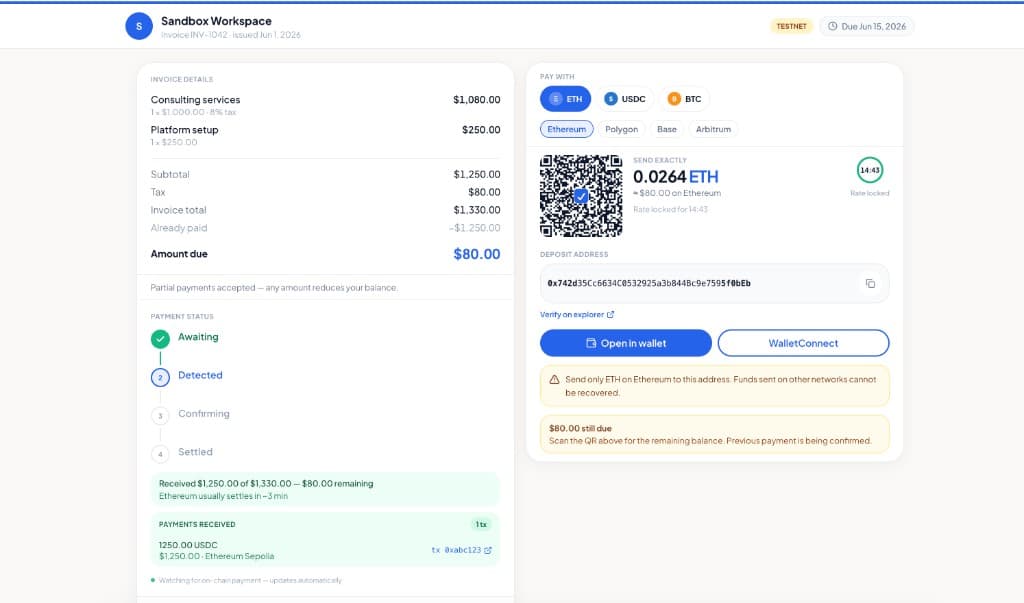
- Brand colors — a small set of theme tokens (primary, accent, background) that restyle the actual payment states a customer sees: pending, awaiting confirmation, underpaid, paid — not just a static landing screen.
- Custom domain — a merchant points a subdomain (e.g. pay.yourcompany.com) at Settlematic via DNS, we verify ownership and automatically issue and renew SSL, and every invoice link for that workspace resolves on the merchant's own domain rather than ours.
The deliberate choice is that none of these three require sales conversations, contracts, or a separate pricing tier the way they do with the white-label gateway providers above — they are configuration, not negotiation. For setup detail on logo, colors, and PDF touchpoints, see custom branding for crypto invoices.
The bottom line
Full white-label branding for crypto payments is not a new idea — it is a well-established, if narrowly marketed, product category. What has been missing is that depth of branding inside an actual invoicing product, available to a business that just wants to send a bill and get paid without becoming a payment reseller to get there. That is the specific gap this comparison points to, and it is the one we built Settlematic's branding stack to close.
Explore Settlematic
Ready to try the workflow in your own workspace? Start on testnet, then explore our how it works guide and product features.
Frequently asked questions
- Do crypto invoicing platforms support custom branding?
- Most support a logo on the invoice document. A smaller number (Acctual, for example) extend that to basic color accents. Full custom-domain support on the hosted payment page itself is rare among dedicated invoicing tools as of mid-2026 — it is more commonly found in white-label crypto gateway products built for payment resellers.
- Can I use my own domain for a crypto payment page?
- With most invoicing-focused platforms, no — the payer is redirected to the provider's domain regardless of your branding settings. Custom-domain hosted checkout is offered by white-label gateway providers (CoinGate, Plisio, NOWPayments, OxaPay, B2BinPay) and by Settlematic, typically requiring DNS verification and automated SSL setup.
- Why didn't Coinbase Commerce support custom domains or logos?
- Coinbase Commerce was built as a self-custodial, any-asset checkout product rather than a white-label platform, and never offered merchant branding for its hosted payment pages during its run. It was shut down for merchants outside the US and Singapore on March 31, 2026 and replaced by Coinbase Business, a custodial platform focused on custody and fiat off-ramps rather than checkout-page customization.
- What is the difference between "logo on an invoice" and a fully white-labeled payment page?
- A logo on an invoice is document-level cosmetic branding — it does not change what the payer sees once they click through to actually pay. A fully white-labeled payment page changes the colors and domain of that payment flow itself, so the entire payer-facing experience — not just the bill — reflects the issuer's brand.
- Is white-label crypto payment branding expensive?
- Among dedicated white-label gateway providers, yes — it is commonly sold as a premium add-on in the $500–$1,000+/month range on top of per-transaction fees, because it is priced for resellers and PSPs managing many merchant brands. Where this capability is built natively into an invoicing product rather than sold as a separate reseller tier, that cost structure does not apply.
Continue reading
- Custom branding for crypto invoices: logos, colors, PDFs, and hosted pages that build trust
- Best crypto invoicing platforms in 2026: an independent buyer's guide
- Request Finance alternatives in 2026: 7 crypto invoicing tools compared (honestly)
- Coinbase Commerce vs a Dedicated Crypto Invoicing Platform for B2B (2026)