What Happens If a Client Pays a Crypto Invoice on the Wrong Chain? (2026)
What to do if a client pays a crypto invoice on the wrong chain or wrong network in 2026 — why it happens, how to prevent it with allowlists and testnet, and recovery basics.
TL;DR
Wrong-chain payments are the most common operational mistake in crypto invoicing — a client sends the right asset on the wrong network. Prevention is far easier than recovery: a strict asset/network allowlist and a testnet dry run stop most cases. When it does happen, recovery depends on the specifics and isn't guaranteed. Here's how to prevent it and what to know.
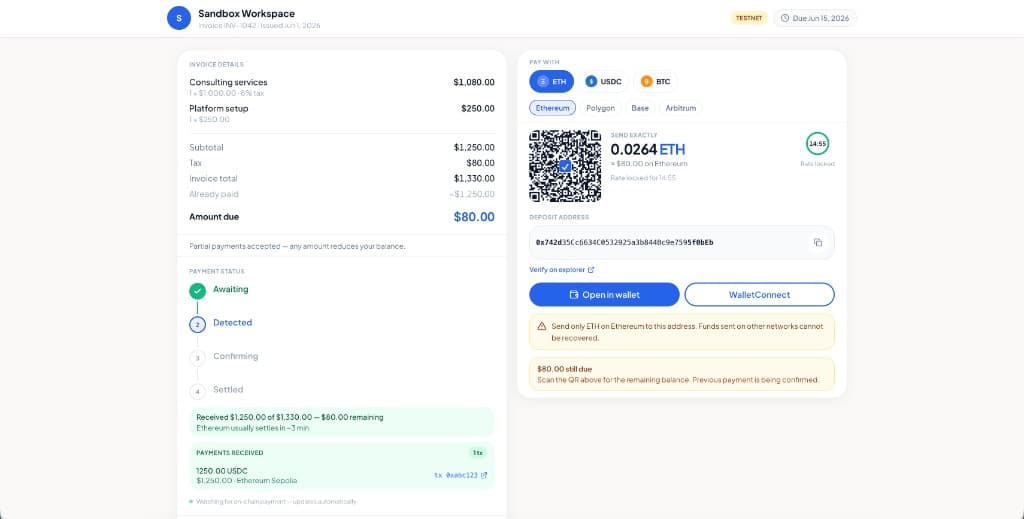
I run product at Settlematic, so this is biased but practical. The prevention advice applies to any platform.
Why it happens
Many assets exist on multiple chains — USDC on Ethereum, Polygon, Solana; USDT on Tron, Ethereum, and more. A client who holds USDC on one network may send it on that network even if you expected another. The asset is "right"; the chain is "wrong." Because the payment page and the client's wallet both involve a network choice, a mismatch is easy to make if nothing constrains it.
Prevention beats recovery, every time
The whole game is stopping the mistake before it happens:
- Use a strict allowlist. Configure the payment page to offer only the asset-and-network pairs you support. If a network isn't offered, the client can't choose it. This is the single most effective control.
- Be explicit in instructions. State "USDC on these networks only" so there's no ambiguity, especially across time zones where a fix could take a day.
- Run a testnet dry run. Test each network you plan to accept by paying yourself first, so the live flow only offers what you've verified.
Get these right and wrong-chain incidents become rare. We list this among the safety practices in is crypto invoicing safe.
If it happens anyway
If a payment lands on a network you didn't expect, recovery depends entirely on the specifics — the asset, the networks involved, whether the receiving address is controlled and usable on that chain, and the platform's capabilities. Sometimes funds sent to an address you control on an unexpected supported chain can still be accessed; sometimes a payment to an incompatible network or address is effectively unrecoverable. There's no universal guarantee, which is exactly why prevention matters so much. If it occurs, contact the platform's support with the transaction details before taking any action, and don't assume a fix is possible.
The bottom line
Wrong-chain payments are preventable with allowlists, clear instructions, and testnet testing — and only sometimes recoverable after the fact. Build the guardrails so it rarely happens. Run a free testnet invoice to confirm your accepted networks before real clients pay.
Explore Settlematic
Ready to try the workflow in your own workspace? Start on testnet, then explore our how it works guide and product features.
Frequently asked questions
- Can wrong-chain crypto payments be recovered?
- Sometimes, depending on the asset, networks, and whether you control a usable address on the chain it landed on — but not always. Recovery is never guaranteed, so prevention is the real answer.
- How do I stop clients paying on the wrong chain?
- Use an allowlist so the payment page only offers supported networks, state accepted networks explicitly, and test on testnet first.
- Whose fault is a wrong-chain payment?
- It's usually an honest mistake. Rather than assign blame, design the flow (allowlist + clear instructions) so the mistake is hard to make.