BTCPay Server vs Hosted Crypto Invoicing: Total Cost of Ownership (2026)
BTCPay Server vs hosted crypto invoicing in 2026 — a clear total-cost-of-ownership comparison covering DevOps, custody, multi-asset support, and which fits which team.
TL;DR
BTCPay Server is open-source, self-hosted, and fully non-custodial — maximum control with no vendor dependency. The trade-off is that "free" software has a real total cost of ownership: DevOps time, hosting, backups, upgrades, and on-call when checkout breaks mid-payment. Hosted invoicing platforms cost a subscription but absorb that operational burden. Here's how to weigh it honestly.
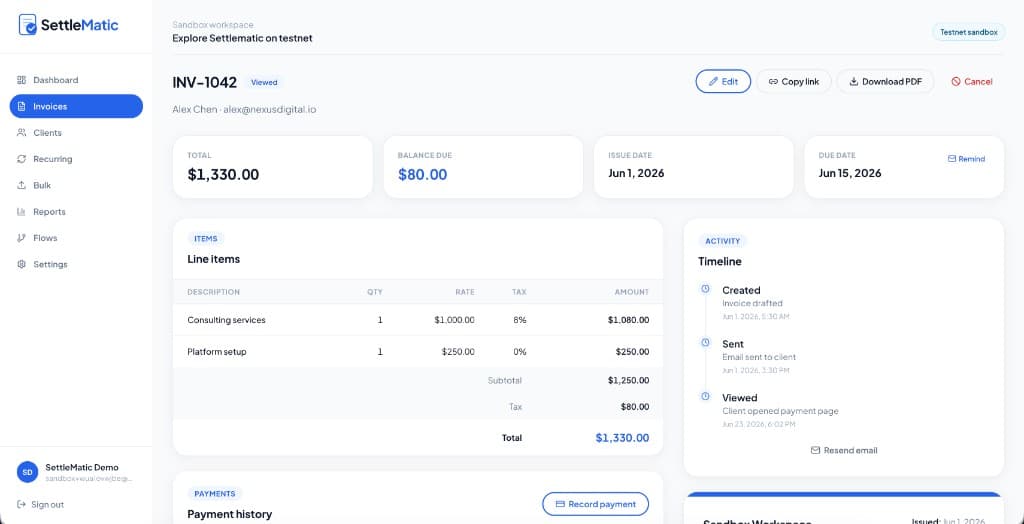
I run product at Settlematic, a hosted platform, so I'll be explicit about the bias and give BTCPay a fair accounting.
What BTCPay Server gets right
BTCPay is genuinely excellent at what it's for. It's open-source, self-hosted, and beloved by Bitcoin-focused and privacy-conscious merchants for good reason: you run the server, you control the keys, you extend via plugins, and you depend on no vendor at all. For a technically strong team that wants sovereignty and primarily handles Bitcoin and Lightning flows, it's often the right answer. Nothing below is a knock on the software.
The "free" cost, itemized
The license is free; the operation is not. An honest total-cost-of-ownership view includes:
- Hosting and infrastructure — running and scaling the server.
- DevOps time — setup, configuration, and ongoing maintenance.
- Upgrade cadence — keeping the server and plugins current and secure.
- Backup and recovery strategy — because you hold the keys, losing them is on you.
- On-call — when checkout breaks during a client's payment window, someone on your team fixes it, possibly on a weekend.
None of these is hypothetical. They're the standard cost of self-hosting any payment-critical infrastructure. For a team with the engineering bandwidth, they're acceptable. For a ten-person agency that needs tax lines and partial stablecoin payments this week, they're a real drag on time you'd rather spend on clients.
What hosted invoicing trades
A hosted platform charges a subscription (and possibly per-transaction fees) and in exchange absorbs the operational burden: infrastructure, uptime, upgrades, and edge cases like reorgs are the vendor's problem, not yours. Hosted invoicing-first tools also tend to lead on multi-asset breadth and finance features — fiat-denominated invoices, partial payments across assets, recurring, tax exports — where BTCPay's strength is Bitcoin-centric flows. The custody question matters here: a non-custodial hosted platform sweeps funds to wallets you control, so you can get self-custody without self-hosting.
A simple decision rule
- Choose BTCPay if you have engineering bandwidth, value zero vendor dependency, and your flows are primarily Bitcoin/Lightning.
- Choose hosted invoicing if you'd rather pay a subscription than run infrastructure, need multi-asset and finance-grade invoicing, and want non-custodial control without the DevOps.
The honest version: BTCPay's "free" beats hosted on cost only if your team's time is free, which it isn't. Price the hours, not just the license.
The bottom line
Both can be non-custodial; the difference is who runs the infrastructure and how broad the invoicing features are. Weigh the subscription against the real hours of self-hosting, and match to your team. To compare the hosted, non-custodial flow without standing up a server, run a free testnet invoice. The wider landscape is in the buyer's guide.
Explore Settlematic
Ready to try the workflow in your own workspace? Start on testnet, then explore our how it works guide and product features.