BitPay Alternatives for Non-Custodial Settlement (2026)
Looking for a BitPay alternative with non-custodial settlement in 2026? A fair comparison of options across custody model, multi-asset support, partial payments, and invoicing depth.
TL;DR
BitPay is an established Bitcoin merchant processor, but its invoicing often implies a custodial model — funds flow through BitPay's infrastructure before you withdraw. If you want funds to land directly in wallets you control, or you need deeper multi-asset and partial-payment support, this guide compares the non-custodial alternatives fairly.
Disclosure: I run product at Settlematic, one of the alternatives below. I'll be straight about where BitPay or another option is the better fit.
What BitPay does well
Credit where due: BitPay built real brand recognition in Bitcoin merchant processing and has a long-operating compliance and onboarding footprint that some merchants find reassuring. If your clients pay primarily in BTC, you want a single established relationship, and you accept the custody trade-off, BitPay belongs on your shortlist. It's a mature processor — that's not nothing.
Why teams look for a non-custodial alternative
The common trigger is custody. BitPay's invoicing typically routes funds through its infrastructure before you withdraw, which means a withdrawal step and a window where the processor sits between you and your money. Teams that want non-custodial settlement — funds swept directly to wallets they control — look elsewhere. Others outgrow BTC-centric processing and need per-invoice ETH/USDC/SOL with partial tranches.
The non-custodial alternatives
Settlematic — invoicing-first, non-custodial, multi-asset
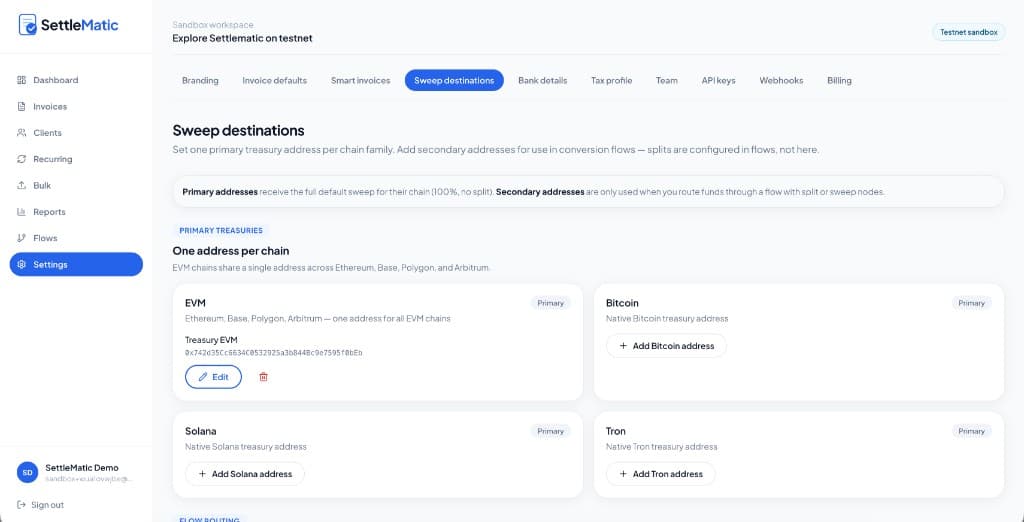
Funds sweep to wallets you control via invoice-scoped addresses; the platform never holds your keys. Fiat-denominated invoices (USD/EUR/GBP) with line items, terms, and branded PDFs; acceptance of ETH, BTC, SOL, USDC, USDT across Ethereum, Polygon, Bitcoin, Solana, and Tron; partial payments across assets on one invoice.
- Best for: teams wanting non-custodial control plus finance-grade invoicing across multiple assets and chains.
- Trade-off: newer brand than a decade-old processor.
BTCPay Server — self-hosted, fully non-custodial
Open-source and self-hosted: you run it, you hold the keys, no vendor dependency at all. The most sovereign option.
- Best for: technically strong, Bitcoin-leaning teams that want zero dependency.
- Trade-off: real DevOps cost — hosting, backups, upgrades, on-call. See BTCPay vs hosted invoicing.
Gilded — treasury-operator focus
Invoicing plus wallet tracking and accounting-oriented views for crypto operators.
- Best for: crypto-first teams with existing treasury workflows.
- Trade-off: evaluate how checkout presents to non-crypto-native clients.
How to choose
Put the custody question first: where do funds sit between payment and my wallet, and who holds the keys? Then check multi-asset and partial-payment depth against how you actually bill. If you're BTC-only and fine with custody, BitPay may still be your answer. If you want self-custody plus invoicing across assets, the alternatives above fit better. The full framework is in the buyer's guide.
The bottom line
The best BitPay alternative depends on how much you value non-custodial control and multi-asset invoicing versus a single established processor relationship. To see non-custodial settlement directly, run a free testnet invoice and watch funds sweep to a wallet you control.
Explore Settlematic
Ready to try the workflow in your own workspace? Start on testnet, then explore our how it works guide and product features.