Best Non-Custodial Crypto Payment Platforms in 2026
A 2026 guide to non-custodial crypto payment platforms — what non-custodial really means, how to evaluate them, and which approach fits invoicing, checkout, and treasury control.
TL;DR
"Non-custodial" should mean the platform never holds your funds — payments route to wallets you control. But the term gets used loosely, so the real work is verifying the claim. This guide explains what to check, how to evaluate non-custodial payment platforms, and where invoicing-first tools fit versus simple checkout.
I run product at Settlematic, a non-custodial platform, so I'll be explicit about that and keep the evaluation criteria objective.
What "non-custodial" must actually mean
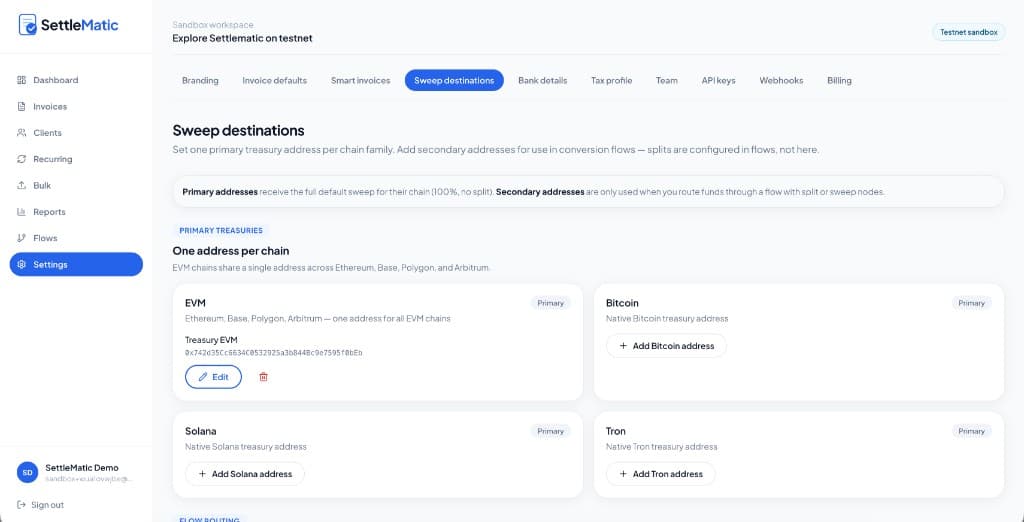
The label is only meaningful if it answers one question correctly: who holds the keys to your funds between payment and withdrawal? In a true non-custodial model, the platform derives a deposit address, detects the payment on-chain, and sweeps it to a destination you control — without ever holding your private keys. If funds sit on the platform's balance until you withdraw, that's custodial, whatever the marketing says. We unpack the mechanics in what is non-custodial [crypto invoicing](/blog/what-is-non-custodial-crypto-invoicing).
How to verify the claim
Don't take "non-custodial" at face value. Ask:
- Where do funds sit between payment and reaching my wallet? The answer should be "they sweep to your wallet," not "your platform balance."
- Who controls the destination wallet's keys? It should be you.
- Can I configure and change the destination? And is there a cooldown window on changes to mitigate account takeover?
- What happens to my funds if the platform goes offline? With true non-custodial settlement, paid funds are already in your wallet.
A platform that answers these crisply is being straight with you. One that's vague is telling you something.
Evaluation criteria beyond custody
Non-custodial is necessary but not sufficient. You still want:
- Fiat-denominated invoicing or checkout, so amounts don't drift with price.
- Multi-chain, multi-asset acceptance so clients can pay how they hold.
- Routing controls — percentage splits to operating and reserve wallets.
- Clean records and exports for reconciliation and tax.
- Account security — 2FA, change cooldowns, audit trails.
Invoicing-first vs simple checkout
Some non-custodial tools are checkout-only: good for one-off acceptance, light on records. Others are invoicing-first: fiat invoices, line items, partial payments, recurring, exports. If you have accounts receivable — recurring clients, milestone billing, tax obligations — invoicing-first is the better fit. If you just need to accept the occasional payment, checkout-only may be enough. The trade-offs are laid out in the independent buyer's guide.
The honest framing
The best non-custodial platform for you is the one whose custody claim survives the four questions above and matches your workflow — invoicing if you have receivables, checkout if you don't. Custody control without good records leaves you reconciling from a block explorer; good records without real non-custody leaves your treasury exposed. You want both.
You can run a free testnet invoice and watch funds sweep to a wallet you control, which is the most direct way to verify a non-custodial claim for yourself.
Explore Settlematic
Ready to try the workflow in your own workspace? Start on testnet, then explore our how it works guide and product features.