How to Accept USDT on Tron for Invoices (2026)
How to accept USDT on the Tron network for invoices in 2026 — why clients choose TRC-20 for low fees, setup, address-format cautions, and non-custodial settlement.
TL;DR
USDT on Tron (the TRC-20 standard) is a popular way for clients to pay because network fees are typically low, which suits everyday and smaller invoices. Accepting it cleanly means allowlisting USDT-on-Tron specifically, quoting in fiat, and watching the address-format difference so payments don't go astray. Here's the setup.
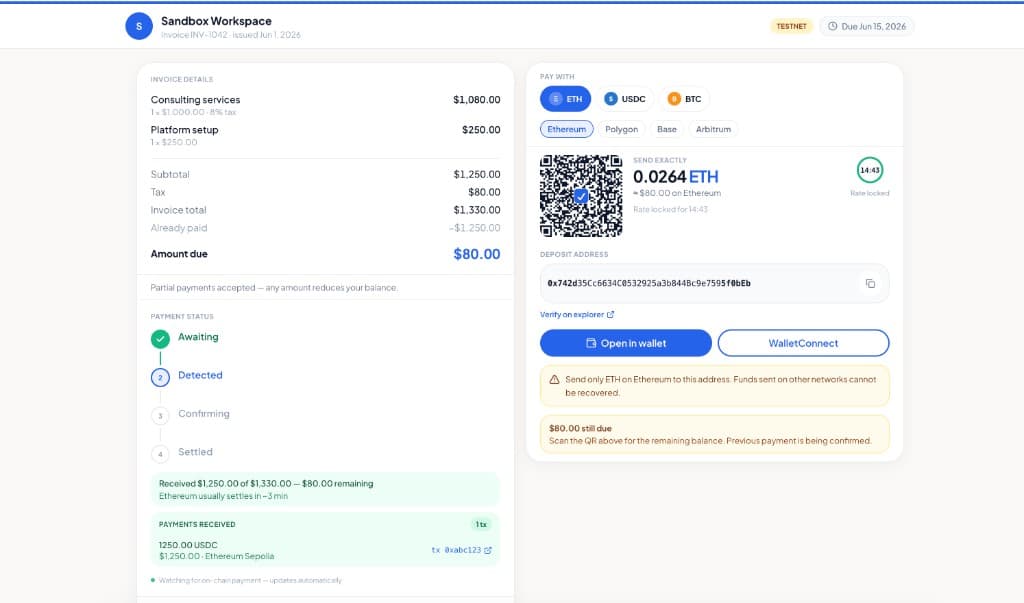
I run product at Settlematic, so this is biased but practical.
Why clients like USDT on Tron
USDT exists on several networks, but Tron is widely used for transfers because its fees tend to be low and predictable. For a client paying a routine invoice, that fee difference is the deciding factor — sending USDT on a high-fee network for a small invoice feels wasteful, so they reach for Tron. If your clients are international or fee-sensitive, accepting USDT on Tron removes a common point of friction.
Setting it up
- Allowlist USDT on Tron specifically. USDT-on-Tron and USDT-on-Ethereum are the same asset on different networks; you accept them as distinct asset-and-network pairs. Add the ones you want.
- Quote in fiat. The invoice shows USD/EUR/GBP; the USDT amount is computed at payment. Because USDT tracks the dollar, the amount maps cleanly. See accepting stablecoins across chains.
- Set the destination wallet that USDT-on-Tron sweeps to, in a non-custodial setup.
- Send the hosted link. The client selects USDT on Tron and pays; the platform detects it and updates the invoice.
The address-format caution
Tron uses a different address format from Ethereum-style chains. That's exactly why the allowlist matters: by offering USDT-on-Tron as an explicit option on the payment page, you avoid a client sending Tron-USDT to an address meant for another network, or vice versa. State "USDT on Tron (TRC-20)" clearly in your instructions, and run a testnet payment on Tron before going live so you've verified the full flow.
When to accept it
If you bill internationally or have fee-sensitive clients, USDT on Tron is worth offering alongside at least one other option. If your clients are enterprise and default to Ethereum, you may not need it — but offering it costs nothing and removes friction for the clients who prefer it. Settlematic supports USDT across Tron and Ethereum among other assets and chains; you choose what to allowlist. (Crypto invoicing.)
The bottom line
Accepting USDT on Tron is mostly about allowlisting the right asset-and-network pair, quoting in fiat, and being clear about the network to avoid address-format mistakes. It's a low-friction option your fee-sensitive clients will appreciate. Run a free testnet invoice to verify the Tron flow before real clients pay.
Explore Settlematic
Ready to try the workflow in your own workspace? Start on testnet, then explore our how it works guide and product features.