Invoicing and checkout with merchant-configured sweeps.
Web3 teams already hold treasury on-chain, so the last thing they need is a payment processor that pools their inbound funds in a custodial balance and pays out on a schedule. What they do need is boring finance plumbing: invoices quoted in USD or EUR that a partner's accounts-payable team will actually approve, checkout that a dapp or API product can embed, and a ledger that reconciles every USDC, USDT, EURC, ETH, or BTC receipt against an invoice or session ID without someone pasting hashes from a block explorer. Settlematic is that plumbing. Every invoice and checkout session gets its own deposit address bound to a wallet you control at the moment it is issued; we watch the chain, confirm the payment, fire a signed webhook, and sweep funds to the multisig, cold wallet, or operating wallet you configured. No pooled balances, no processor custody, no percentage of volume.
Overview
Web3 payments infrastructure for DAOs, protocols, and crypto-native companies: fiat-quoted partner invoicing, embeddable multi-chain checkout, invoice-scoped addresses bound to your own wallets, signed webhooks, and merchant-configured sweeps — with a full testnet environment before mainnet.
Networks
8
Ethereum, Polygon, Base, Arbitrum, Arc, Solana, Tron, and Bitcoin
Custody
None
Addresses bound to your wallets at issuance
Testnet
Free
Full platform access before mainnet
Checkout
4 modes
Hosted, embedded, iframe, QR
Definition
What is Web3 teams?
Settlematic for Web3 teams combines Collect (fiat-quoted invoicing paid in stablecoins or native assets) with Gateway (hosted, embedded, iframe, and API-driven checkout for products and platforms). Both share one non-custodial settlement layer: deposit addresses are derived for wallets you control, payments are detected on-chain, and confirmed funds are swept to destinations you set. Settlematic never holds private keys or key shards that can move your funds.
Settlement
Sweeps to wallets you configure — including your multisig
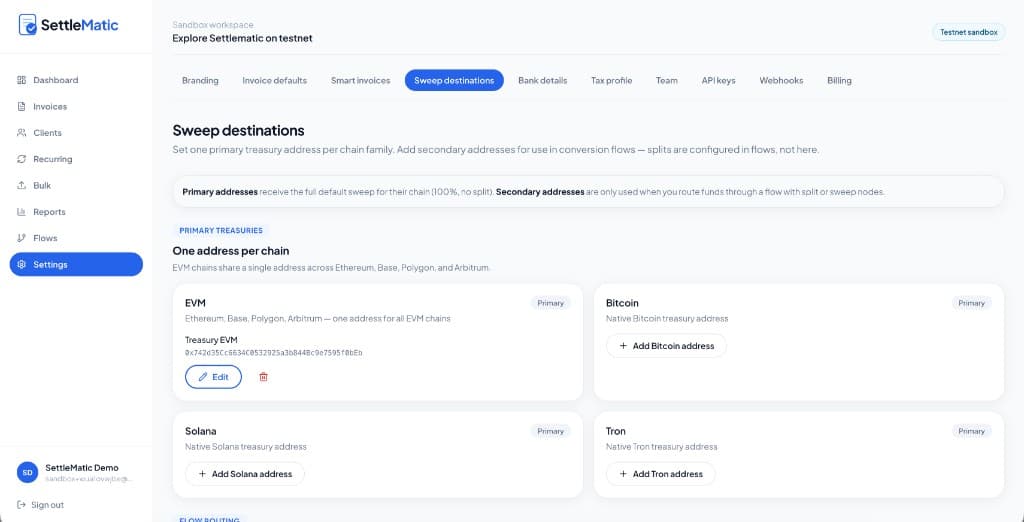
Each invoice or checkout session gets a fresh deposit address derived for a destination you control. When the payment confirms, Settlematic sweeps it to that destination: a Safe multisig, a hardware-wallet cold address, or an operating wallet per business unit. Destinations are fixed at issuance, so nobody — including Settlematic — can redirect a payment after the fact. Sweep rules can differ per asset and network: USDC on Polygon to the ops wallet, ETH to cold storage, BTC left in place.
- Merchant-configured sweep destinations per asset and network
- Invoice-scoped deposit addresses, never reused across payers
- Dual-source on-chain detection before an invoice is marked paid
- Signed webhooks (HMAC) with delivery and retry logs
Partners
Invoice ecosystem partners in fiat, settle in stablecoins
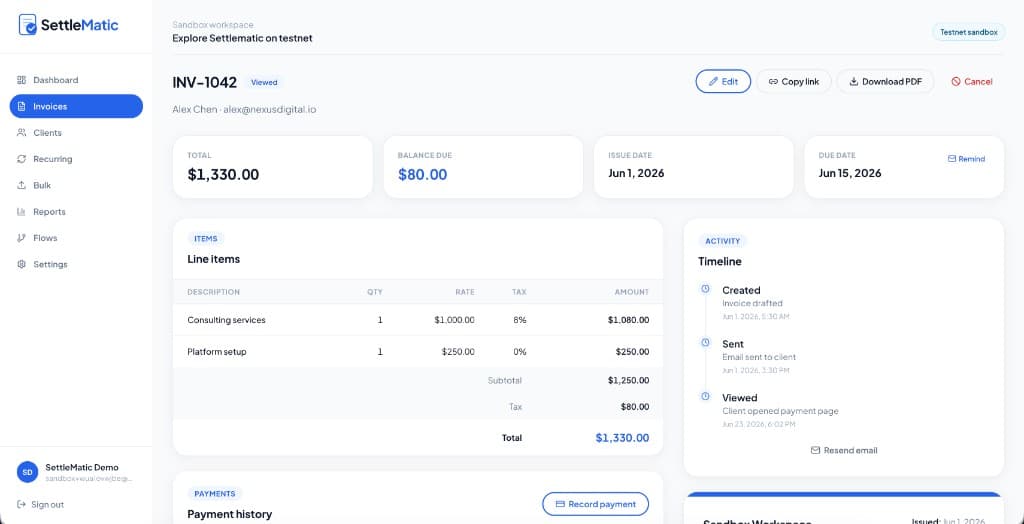
Not every counterparty is on-chain native, and even the ones that are usually have a finance team that thinks in dollars. Collect issues invoices quoted in USD, EUR, or GBP with line items, tax buckets, PO references, and payment terms, then lets the payer choose USDC, USDT, EURC, ETH, or BTC on the chain they hold it. The fiat amount is locked for the payment window, so a partner paying a $25,000 integration fee sends exactly the stablecoin amount due, and your ledger records the fiat value at the time of payment for tax purposes.
- USD, EUR, and GBP quotes with locked exchange rates
- Line items, tax fields, PO numbers, and due dates on every invoice
- Partial payments and early-payment discounts as invoice terms
- Recurring invoices for retainers, grants, and service agreements
Product checkout
Embed checkout in your dapp, API, or marketplace
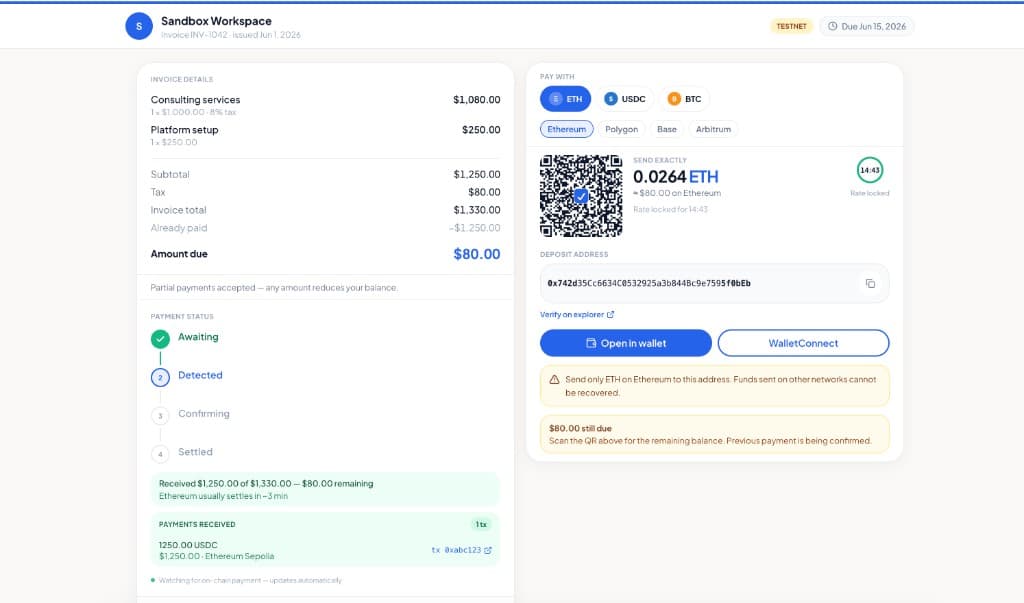
Gateway creates checkout sessions from your backend and renders them as a hosted page, an embedded component, an iframe, or a QR flow — the same detection and settlement rails as Collect. Platforms that onboard their own merchants get multi-merchant operations: per-merchant API keys, allowed assets, KYB workflows, refunds, and audit logs, with each merchant's funds settling to that merchant's own wallet rather than a platform-controlled pool.
- REST API for sessions, invoices, and payment links
- Multi-merchant onboarding with scoped keys per environment
- Sandbox merchants on testnet that mirror production behavior
- Customer portal for payment status and receipts
Automation
Webhooks and agents, not dashboards
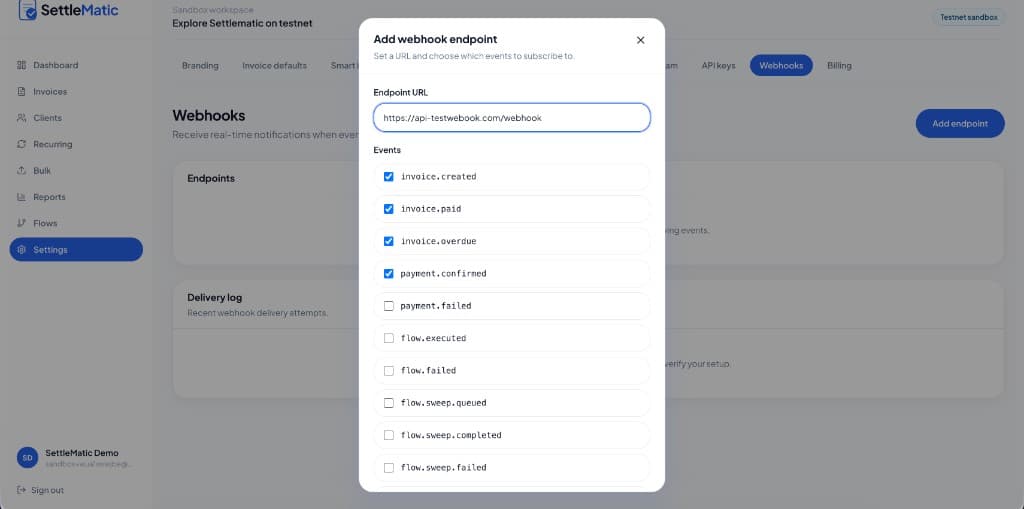
Crypto-native teams automate. Every payment lifecycle event — created, detected, confirmed, swept, underpaid, wrong-chain — is delivered as a signed webhook you can verify and replay. Teams operating from Claude or other assistants can use the Settlematic MCP server to query receivables, draft invoices, and check settlement status from conversation, with confirmation gates before anything client-facing is sent.
- payment.confirmed, invoice.paid, and sweep.completed events
- Idempotent delivery with replay from the dashboard
- MCP server for Claude-driven AR workflows
- Wrong-chain and underpayment detection with recovery flows
Reporting
Reports your accountant and your DAO can both read
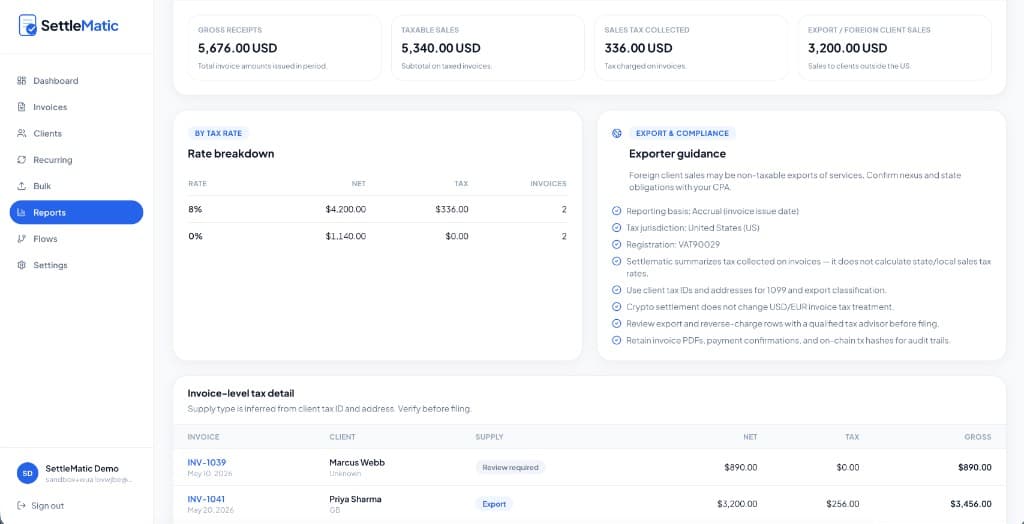
Each payment is recorded with the invoice ID, payer, asset, network, transaction hash, block confirmation, fiat value at receipt, and sweep destination. Export CSV or JSON by period for QuickBooks, Xero, or a governance report; every row carries the on-chain reference so a treasury committee can verify it independently. Tax buckets on line items carry through, so VAT, GST, or sales-tax reporting starts from the invoice, not from a wallet export.
- Fiat value at time of receipt on every record
- Transaction hash and confirmation height per payment
- CSV and JSON exports for accounting and governance
- Tax buckets carried from line item to report
Workflow
How web3 teams teams use Settlematic
- 1
Receive
Partner or client pays via Collect or Gateway checkout
- 2
Confirm
On-chain detection updates invoice or session status
- 3
Sweep
Configured rules move funds to your wallets
- 4
Automate
Webhooks drive internal ops and provisioning
- 5
Audit
Export payment reports with on-chain references
Problems we solve
Teams in web3 teams often hit the same operational walls before adopting unified crypto finance infrastructure.
Partner billing that AP teams reject
A wallet address in a Notion doc is not an invoice. Ecosystem partners, grant programs, and enterprise integrators need a numbered, fiat-denominated invoice with line items, tax fields, and a due date before their finance team will release funds — even when they intend to pay in USDC.
Fragmented payment tooling
Partner invoices live in one tool, product checkout in another, and grant disbursements in a spreadsheet. Nothing shares a ledger, so month-end means reconciling three sources against the chain by hand.
Manual wallet ops
Without invoice-scoped addresses and webhooks, every inbound payment is a block-explorer investigation: which sender, which invoice, which chain, was the amount short, did they pay USDT on Tron when the invoice asked for Polygon?
Custodial off-ramps for on-chain teams
Most crypto payment gateways forward funds from a pooled processor balance on a settlement schedule. For a team that already runs a multisig, that is a step backwards: added counterparty risk, delayed finality, and a percentage fee on volume you could have received directly.
Recommended modules
Start with the modules most teams in web3 teams deploy first.
Yes. Collect and Gateway are available on testnet - including sandbox merchants and sample invoices.
Related industries
SaaS & agencies
Invoice in USD or EUR, let clients pay in USDC or other assets on their preferred chain, and export reconciliation data for month-end close.
Platforms
Onboard merchants via API, issue checkout sessions, and receive signed webhooks when payments land - with sandbox merchants for integration testing.
Start with Web3 teams
Create a free testnet account or open a sandbox demo with sample data.