Settlematic vs. BitPay: An Honest Comparison for Merchants
BitPay holds funds until settlement; Settlematic never can. Compare real 2026 fees, payout timing, chains, and country coverage — with sourced figures.
Do this next
Compare custody models
- Custodial processors hold keys and convert.
- Non-custodial settlement binds addresses to your wallet.
- Use the table below for the attribute-level split.
TL;DR
BitPay is a custodial processor — it receives your customer's crypto, converts it, holds the balance on its ledger, and pays you out on a daily settlement cycle. Settlematic is non-custodial — payments settle directly to wallets you control, with no ledger balance and no payout step. BitPay charges 1–2% + 25¢ per transaction; Settlematic charges a flat monthly subscription with no percentage of volume. Which is cheaper depends on your volume. Which is safer depends on how you feel about a third party holding your revenue for a few days.
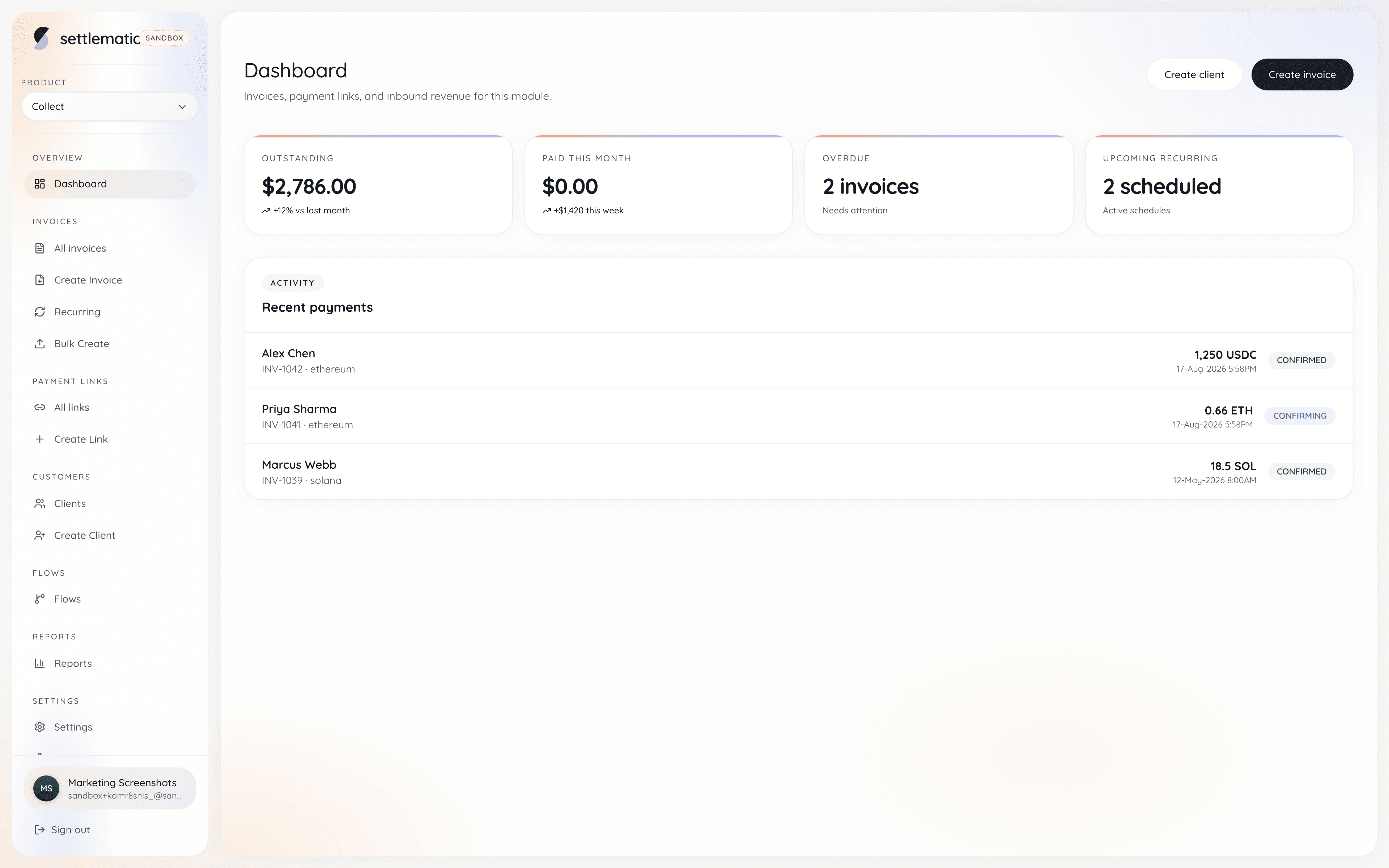
Short answer: BitPay is a custodial processor — it receives your customer's crypto, converts it, holds the balance on its ledger, and pays you out on a daily settlement cycle. Settlematic is non-custodial — payments settle directly to wallets you control, with no ledger balance and no payout step. BitPay charges 1–2% + 25¢ per transaction; Settlematic charges a flat monthly subscription and no percentage of volume. Which is cheaper depends entirely on your volume. Which is safer depends on how you feel about a third party holding your revenue for a few days.
We build Settlematic, so treat this as an informed but interested comparison. Every BitPay figure below is sourced to BitPay's own documentation, with links, and last verified on 18 August 2026. Where BitPay is the better choice, we say so — there are several such cases.
The structural difference, in BitPay's own words
Most comparison pages argue about custody. BitPay's Merchant Terms of Use settle it directly. Describing how payments reach you, the document explains that BitPay clears payments to your account ledger, and that these ledger entries are funds temporarily held by BitPay until settlement to your bank account or wallet.
That is a clear, accurate description of a custodial model, and BitPay is not hiding it. The mechanics are documented in detail: when someone pays a BitPay invoice, BitPay receives the payment at a controlled address, then combines multiple small payments — a UTXO sweep — and sends the consolidated funds to exchanges to convert into fiat for merchants.
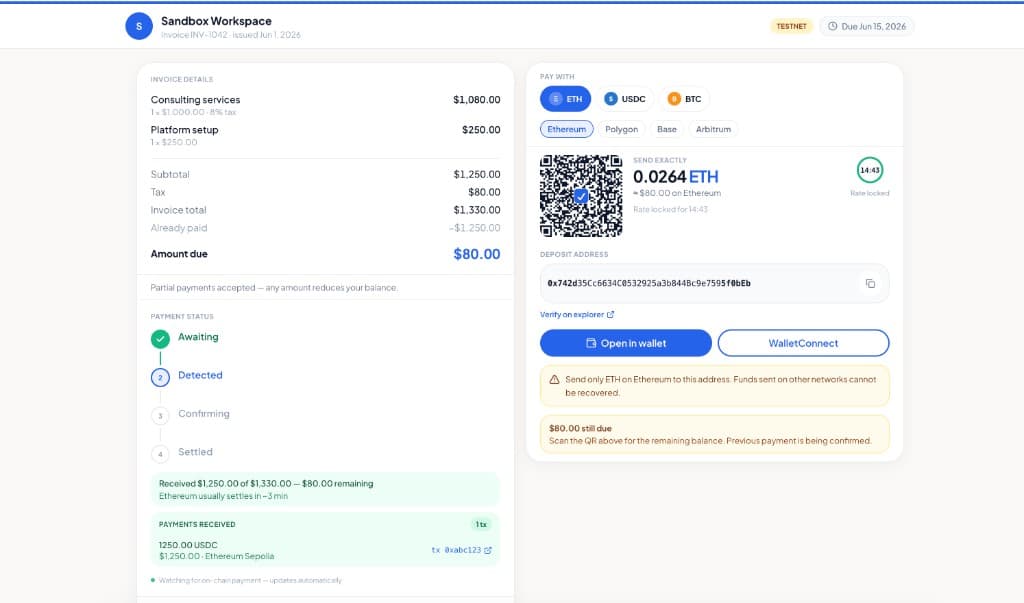
Settlematic inverts this. There is no controlled address, no consolidation, and no conversion step. Each invoice or checkout session generates a deposit address cryptographically bound at issuance to a settlement destination you configure — cold storage, an operating wallet, or a multisig. We detect the confirmation on-chain, reconcile it, and fire your webhook. We never hold keys and cannot redirect an address once issued. See Collect for invoicing and Gateway for checkout.
The practical consequence: with BitPay there is a window — typically one to three business days — during which your revenue exists as a claim against BitPay rather than as an asset you own. With Settlematic there is no such window, because there is no intermediary balance.
For the full argument on why that matters, including the Celsius bankruptcy rulings where custody-account holders recovered 100% and Earn-account holders recovered 15–72%, see our explainer on custodial vs. non-custodial processors.
Pricing: the honest math
This is where the comparison gets genuinely interesting, because the two models don't just differ in price — they differ in shape.
BitPay's structure
BitPay's support documentation states pricing as 1–2% + 25¢ per transaction, assessed on each paid invoice, with fees debited from your ledger. Third-party analyses of the tiering report it as 2% + 25¢ under $500,000/month, 1.5% + 25¢ between $500,000 and $999,999, and 1% + 25¢ above $1,000,000.
Read that tiering carefully. The headline "1–2%" is accurate, but the rate drops to 1% only above $1M monthly, so for merchants who never clear half a million a month — which is most — the effective rate is the top of the range.
There's also a separate line item your customer sees. BitPay applies a Network Cost to cover the consolidation transaction: calculated using Bitcoin Core's "Conservative" two-block fee estimate, and charged to the purchaser as a separate line item if it exceeds $0.01 or 0.05% of the invoice price. This fluctuates with congestion — as of early 2026 Bitcoin's average transaction fee sits around $0.82, but individual invoices may vary.
And if you refund a customer, BitPay deducts the miner fee amount from your merchant ledger balance.
Settlematic's structure
Flat subscription, no take-rate: Collect from $20/month on Lite, Gateway on the Pro plan at $49/month, with a 7-day Pro trial and a free sandbox. Settlematic does not charge a percentage of payment volume and does not add a per-invoice processor fee on top of the subscription. Network fees are paid on-chain by whoever sends the transaction, as with any wallet-to-wallet transfer — there's no consolidation sweep to fund, because there's no consolidation. Optional Gateway platform-fee splits, if you configure them for sub-merchants, are amounts you set and receive — not a Settlematic commission. See pricing for current plan limits.
What this means at different volumes
| Monthly volume | BitPay (2% + 25¢, ~50 txns) | Settlematic Pro ($49/mo) |
|---|---|---|
| $2,000 | ~$52 | $49 + network |
| $10,000 | ~$212 | $49 + network |
| $50,000 | ~$1,012 | $49 + network |
| $250,000 | ~$5,012 | $49 + network |
Your actual BitPay cost depends on ticket size, transaction count, and settlement currency.
The crossover is the entire story. Below roughly $2,500/month in volume, percentage pricing is competitive or cheaper. Above that, flat pricing pulls ahead quickly, and by mid-five-figure volumes the gap is an order of magnitude. This is not a clever pricing trick on our part — it's simply what happens when one model scales with your revenue and the other doesn't.
The cost line most comparisons miss
If you settle to a non-USD bank account, there's a conversion margin on top of the processor fee. Independent 2026 analysis notes that BitPay quotes a volume-tiered settlement fee, but cross-currency conversion to a non-USD bank account adds a margin set by their banking partner. BitPay's own settlement documentation adds that merchants invoicing in a different currency from their settlement currency receive the exchange rate calculated when the invoice was generated, using rates from openexchangerates.org.
For UK, EU, Australian, and Cypriot merchants — where the settlement currency is rarely USD — this is a real cost that never appears in a headline rate comparison. Model it.
Settlement: daily batches vs. no batch at all
BitPay's settlement process is well documented and, by custodial standards, fast. Settlement happens automatically every business day, collecting all payments processed since the previous business day's settlement. But there are three constraints worth knowing before you commit:
- Minimums. The minimum settlement is 20 USD, and USD settlements to banks outside the USA are delivered via wire. EUR settlement carries a higher bar: BitPay's settlement docs currently list a 500 EUR SEPA minimum. There are jurisdiction-specific exceptions too — merchants settled in EUR located in Gibraltar face a settlement minimum of 2000 EUR.
- Bank timing. Once a USD settlement payment has been issued, funds appear in your bank account after two business days. EUR SEPA settlements are documented as appearing after one business day.
- Reserves and freezes. For merchants also using payouts, BitPay documents a reserve mechanism where regular account settlement occurs only if your available balance exceeds a specified reserve amount, and describes placing settlements on hold as a freeze on your settlements, which a BitPay agent must remove — it cannot be removed on your side.
That last detail is the clearest illustration of the custodial trade-off. It is a sensible operational control, and it exists because BitPay holds the funds. Settlematic cannot freeze settled funds because it never holds them; the most it can do is prevent you from issuing new invoices. That is the same distinction we walk through in custodial vs. non-custodial processors.
Settlematic's timing: the settlement is the payment. On-chain confirmation lands funds in your wallet directly — typically seconds to minutes depending on chain, with no minimum, no batch window, no reserve, and no business-day dependency. Nothing settles on a Monday because a payment arrived on Friday evening.
Head to head
| Dimension | BitPay | Settlematic |
|---|---|---|
| Custody model | Custodial — funds temporarily held until settlement | Non-custodial — addresses bound to your wallets at issuance |
| Pricing | 1–2% + 25¢ per transaction | Flat subscription from $20/mo (Collect), $49/mo (Gateway on Pro); no % of volume |
| Who pays network fees | Network Cost charged to the purchaser | On-chain, paid by sender |
| Payout timing | Daily, every business day, then two business days to bank | On-chain confirmation; no payout step |
| Settlement minimum | 20 USD / 500 EUR | None |
| Fiat bank deposit | Direct bank deposits in 37 countries | Not built in — you off-ramp separately |
| Crypto settlement reach | 15 cryptocurrencies, 200+ countries | USDC, USDT, EURC across 6 chains, 70+ countries |
| Chains | Broad multi-coin incl. BTC, ETH, LTC, DOGE, XRP | Ethereum, Polygon, BSC, Solana, Tron, Bitcoin |
| Refund handling | Built in; miner fee deducted from merchant ledger | Manual — on-chain payments are final |
| Account freeze possible | Yes — removable only by a BitPay agent | Cannot freeze settled funds |
| Onboarding | KYB and Enhanced Due Diligence, usual turnaround 1–2 weeks | KYB/KYC available; sandbox immediately |
| Track record | Founded 2011, Atlanta; over a decade operating | Newer entrant — shorter operating history |
Where BitPay is the better choice
Being straight about this is more useful to you than a clean sweep, and there are four scenarios where we'd point you to BitPay:
1. You need money in a bank account automatically. This is the biggest one. BitPay supports direct bank deposits in 37 countries and handles conversion for you. Settlematic settles in stablecoins to your wallet; converting to fiat and moving it to a bank is your problem to solve. If your finance team has no appetite for holding USDC, that operational gap matters more than any custody argument.
2. You need broad coin coverage. BitPay supports settlement in 15 cryptocurrencies including BTC, ETH, LTC, DOGE, XRP, USDC, USDT, DAI and others. If customers pay you in Dogecoin or XRP, Settlematic's stablecoin-plus-Bitcoin focus won't serve you.
3. Your volume is genuinely small. At $2,000/month, percentage pricing costs about the same as our subscription and comes with fiat conversion included. Buy convenience.
4. You need refund and dispute machinery. BitPay has documented processes for refunds, underpayments and overpayments. Non-custodial settlement is final; refunds are a manual outbound payment from your wallet. If you run consumer e-commerce with meaningful return rates, that's a real workflow gap.
A fifth, honest one: operating history. BitPay has processed crypto payments since 2011 and, as one review notes, has operated for over a decade without being shut down by regulators. We're newer. If vendor longevity is your primary risk criterion, weigh that — though note that with non-custodial settlement, vendor longevity risk is structurally smaller, because our disappearing wouldn't strand your funds.
What merchants actually report
Reviews here need careful reading, because the two audiences diverge sharply and most comparison pages quote only the number that suits them.
BitPay's consumer-facing ratings are poor: 1.2 out of 5 on Trustpilot across 291 reviews, with most citing customer support, locked accounts, and inability to access funds. But an RFP-focused analysis flags the split directly — G2-style merchant reviews skew moderately positive while consumer Trustpilot reviews skew very negative — and BitPay's merchant rating on Capterra sits at 4.4 out of 5, though from only 17 verified reviews.
The most likely explanation is that BitPay is a merchant product being rated largely by consumers who encountered it at someone else's checkout, plus wallet users. That's a genuine mitigating context, and quoting the 1.2 without it would be misleading.
That said, the recurring merchant-side themes are consistent across sources and worth taking seriously in your evaluation: complaints reference refunds, underpayments and fee surprises, and reports of account access issues, alongside praise that integrations and invoicing workflows reduce operational friction and stablecoin settlement options are practical for businesses. Onboarding friction appears in merchant reviews too — one long-term user noted approval taking weeks as their main complaint.
Settlematic has a far smaller review base, which is itself a data point you should weigh. Test us in the free sandbox rather than taking our word for it.
Regulatory positioning for UK, EU, Australian and US merchants
Custody is the trigger for the heaviest regulatory obligations in every market you likely operate in, which has knock-on effects for both vendors and you.
Under MiCA, custody means safekeeping crypto-assets or the means of access to them — private cryptographic keys — or exercising control over them on a client's behalf, and it carries a €125,000 own-funds requirement plus segregation, daily reconciliation and quarterly client reporting duties. The UK applies the same logic: safeguarding covers custody on behalf of another person, including control of the means of access such as private cryptographic keys. Australia's framework, per practitioners, rests on the long-standing regulatory principle that custody creates fiduciary responsibilities irrespective of the technological medium.
This cuts both ways, and here's the fair reading:
- Custodial processors carry heavier licensing — which means more capital, more oversight, and arguably more accountability. That's a point for BitPay, not against it.
- But you inherit their regulatory posture. BitPay's own documentation shows jurisdiction-specific constraints flowing down to merchants: Japanese merchants may not take settlement in foreign-backed stablecoins including USDC, EUROC, DAI, GUSD and USDP/PAX, and merchants registered in New York may only take settlement in USD, BTC, BCH, ETH, or USDC.
Those aren't criticisms of BitPay — they're compliance obligations correctly implemented. But they illustrate the trade: with a custodial processor, your available settlement options are shaped by your processor's licences and banking relationships. With non-custodial settlement, funds move to your wallet under your own regulatory posture.
Note that non-custodial does not mean unregulated. Settlematic supports KYB/KYC merchant onboarding and Travel Rule workflows; AML and sanctions obligations attach to payment services regardless of custody. Read more on our security architecture.
How to decide
Work through these in order:
- Do you need automatic fiat in a bank account? If yes and you can't build the off-ramp yourself → BitPay.
- What's your monthly volume? Under ~$2,500 → percentage pricing is fine. Over ~$10,000 → flat pricing saves substantially.
- Do customers pay in assets beyond USDC/USDT/EURC/BTC? If yes → BitPay's coin coverage wins.
- How much does a 1–3 day settlement float cost you? If cash flow is tight or amounts are large, this is the decisive question.
- Would a settlement freeze be survivable? If a hold on your revenue would be an existential problem, the custodial model is the risk you're accepting.
Most merchants who switch to non-custodial do so for reason 4 or 5, not reason 2. The pricing is what gets noticed; the float is what actually hurts.
The bottom line
BitPay is a mature, well-documented custodial processor that solves the crypto-to-bank-account problem better than we do. If that's your main constraint, it's a reasonable choice, and its longevity is a real credential.
Settlematic is for merchants who've decided that a third party holding their revenue — even for two business days, even competently — is a risk they'd rather engineer away than manage. The trade is explicit: you take on wallet and off-ramp responsibility, and in return no one can hold, freeze, or delay funds that are already yours.
Test both. Try the free sandbox with no card required, run a real invoice end to end, and compare the settlement experience against your current processor before deciding.
All BitPay figures sourced from BitPay's published support documentation, developer documentation, and Merchant Terms of Use, plus named third-party analyses, verified 18 August 2026. Pricing and policies change — check bitpay.com/pricing and developer.bitpay.com/docs/settlement for current terms. BitPay is a trademark of its respective owner; Settlematic is not affiliated with BitPay.
Sources
Frequently asked questions
- Does BitPay hold your funds?
- Yes, temporarily. BitPay's Merchant Terms of Use describe ledger balances as funds temporarily held by BitPay until settlement to your bank account or wallet. Settlement then runs automatically every business day.
- How long does BitPay take to pay out?
- Settlement is initiated daily on business days. USD bank deposits appear two business days after a settlement payment is issued (20 USD minimum). EUR SEPA deposits are documented as one business day, with a 500 EUR minimum.
- Is Settlematic cheaper than BitPay?
- Above roughly $2,500/month in volume, yes — often dramatically, since a flat subscription doesn't scale with revenue while 2% + 25¢ per transaction does. Settlematic does not take a percentage of payments. Below that, BitPay is competitive and includes fiat conversion.
- Can Settlematic freeze my account?
- It can suspend new invoice creation. It cannot freeze settled funds, because those went directly to wallets you control and were never held by Settlematic.
- Does Settlematic convert crypto to fiat and deposit to my bank?
- No. You receive stablecoins in your own wallet and arrange off-ramping yourself. If you need automatic bank settlement, BitPay's direct bank deposits in 37 countries is a genuine advantage.
- What chains and coins does each support?
- Settlematic: USDC, USDT and EURC across Ethereum, Polygon, BSC, Solana, Tron and Bitcoin. BitPay: settlement in 15 cryptocurrencies, with crypto settlement supported in over 200 countries.
- How long does onboarding take?
- BitPay's payouts documentation cites Know Your Business and Enhanced Due Diligence with a usual turnaround of 1–2 weeks. Settlematic offers a free sandbox you can test immediately, with KYB where required.